
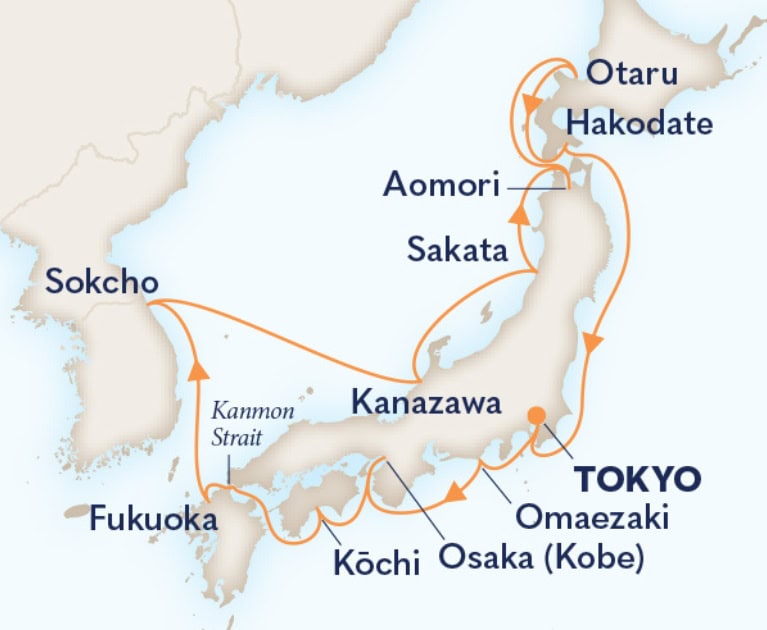
On this 14-night roundtrip Tokyo cruise, you’ll visit these destinations:
Tokyo is the largest city on earth and packed with some of the world’s best shops, museums and restaurants, big and small. While the bright neon lights and the bustle of contemporary Tokyo may be what comes to mind when you think of the city, there is another side.
Cruises to Omaezaki, Japan arrive to a laid-back seaside town in the Shizuoka Prefecture, which is about two hours by train from Tokyo. Rolling hills and wide, wind-swept beaches make Omaezaki a favorite destination for a weekend escape. It offers the best windsurfing in Japan, but if you aren’t up to ride the waves, there are plenty of other things to do in Shizuoka and Omaezaki. Climb the spiral stairs of the Omaezaki Lighthouse to sweeping views of azure water. Stretch out on a sandy, secluded beach surrounded by rippled dunes at Hamaoka Sand Dunes. Visit the market and treat yourself to fresh seafood and traditional Japanese treats. Shizuoka is also world-famous for green tea. Stroll among neat rows of verdant tea at tea fields in Makinohara, a thirty-minute taxi from the Omaezaki port. In early spring, expect cherry blossom festivities at the major attractions.
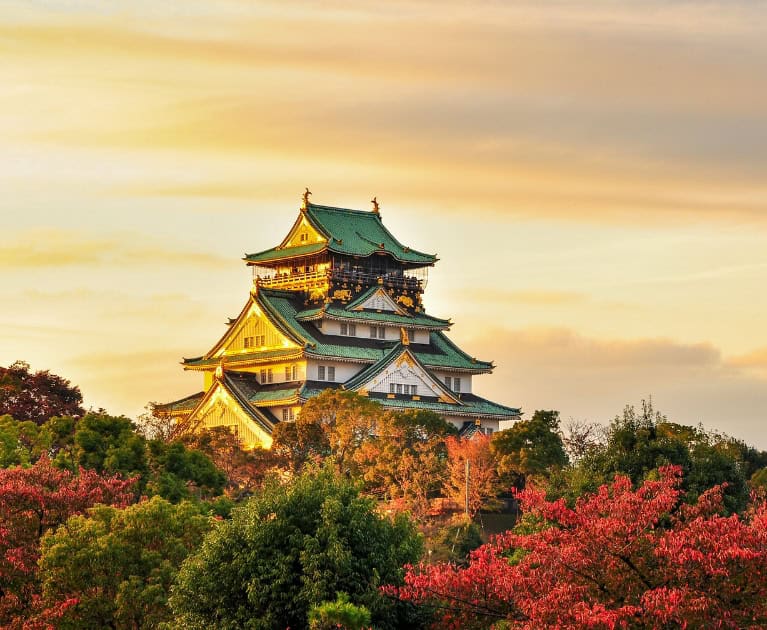
Think of Osaka, Japan, with the emphasis on the O, as a lively blend of Los Angeles and Chicago. It has the confidence of a city that knows its own worth, paired with the straight talking warmth often associated with Chicago. Business is taken seriously here, and local pride runs deep, especially when it comes to the Hanshin Tigers. Win or lose, they are passionately supported as the city’s team. People in Osaka are known for their big laughs, energetic social lives and love of a good night out, often outdoing even Tokyo in sheer enthusiasm. The city also has its own distinctive dialect, a reflection of its strong identity and independence, setting it apart even from nearby Kobe. Osaka is a city shaped by resilience and renewal. Much of it was rebuilt after the war, resulting in a modern urban landscape defined by bold architecture, concrete and steel. While green spaces are fewer, the city makes up for it with a dynamic streetscape that feels constantly alive and in motion. There is never a shortage of memorable sights. Sumo wrestlers wait for trains, carrying the unmistakable aroma of chanko nabe, their traditional high energy meals. Groups of yakuza quietly occupy train carriages, creating an oddly calm and orderly presence. Bustling markets, glowing neon signs and busy shopping streets showcase Osaka’s drive, ambition and unmistakable character. And when you want a change of pace, Osaka’s location is hard to beat. Less than an hour away are some of the most beautiful temples, shrines and historic sites in Japan, with the ancient capitals of Kyoto and Nara offering over a thousand years of culture and history right on the doorstep.
High atop a hill in Kochi sits 17th-century Kochi Castle, once the seat of the Yamauchi lords. Explore this historic site and enjoy panoramic views of the city, then dine on sushi at Hirome Market.
Fukuoka, Kyushu’s largest city, was once two separate entities: Fukuoka in the west and the merchant area of Hakata to the east. Joined together in 1889, the contemporary city—population 1.5 million—has a lively, modern atmosphere, an array of impressive architecture by international starchitects, including Rem Koolhaas, César Pelli, Emilio Ambasz and Aldo Rossi, and a number of cultural attractions and museums such as the Fukuoka Asian Art Museum. Modern developments like Canal City—a mixed-use complex designed by American Jon Jerde that contains hotels, cinemas, restaurants and shops—lend the city space a futuristic air, as does the striking 234-metre Fukuoka Tower, which is covered in mirrored glass and has an observation deck. On the historical side, sites like the Kushida Shrine and the ruins of Fukuoka Castle offer traditional and cultural insights. The pond in the centre of Ōhori, Fukuoka’s largest park, was once part of Fukuoka Castle’s moat, and you’ll find gardens, a zoo, an amusement park and a car museum in Uminonakamichi Seaside Park.
Guests on cruises to Sokcho arrive to a coastal city in northeast South Korea, a must for anyone who wants to experience the natural beauty and culture of the country. Part of North Korea until the late 1940s, Sokcho is now a buzzing fishing hub. Dock at Daepo Harbor on the Sea of Japan (East Sea). Soon after you get off the ship, make your way through a maze of eateries and street vendors clustered around the cruise port. Snack on seafood in all forms— shrimp, crab, squid, and fish, deep-fried, pickled, raw or dried. Visit Sokcho Central Market, a lively, traditional marketplace for an authentic taste of life in Sokcho. If you see sundae on the menu, don’t expect ice cream. Sundae is a popular street food made from Korean blood sausage. Vegetarians should try soft tofu dishes, another specialty in the area. Wash it all down with makgeolli, a milky rice wine. Dramatic scenery surrounds the city. Seoraksan National Park’s serene forests, jagged granite peaks and crystal-clear streams are only 30 minutes by bus from the cruise terminal. Amble an easy trail or embark on a strenuous three-hour trek to the Geum-gang-gul cave temple. If you want a more relaxing experience, take a cable car ride to the top of Mt. Seoraksan to admire endless views of cliffs and coastlines. Before your day in Sokcho is complete, pop into Sokcho Beach near the port to unwind amid golden sands and turquoise surf.
Located on the shores of the Sea of Japan, Kanazawa is a bustling hub with ships arriving and departing for South Korea, Russia and China. The port is just west of the city centre—a former samurai town that was once one of the largest in Japan. Like Kyoto, the city escaped bombing in World War II, and its historic buildings provide a glimpse of old Japan. Of the three teahouse (chaya, in Japanese) neighbourhoods, the most famous is the charming Higashi Chaya District. Contemporary Kanazawa has its attractions, too. Sophisticated restaurants serve delicious Kaga cuisine, which highlights the bounty of the sea. (Kaga is the traditional name for this part of Japan.) Shops sell Kaga-nui pottery, Kutani porcelain and other handicrafts. Major sights include Kenrokuen—a 17th-century garden that is a high point of landscape design in Japan—and Kanazawa Castle and its park. At the Kanazawa Noh Museum, visitors can learn about Noh theatre and storytelling, while the 21st Century Museum of Contemporary Art features both Japanese and international artists (it’s located next to Kenrokuen). Nearby, there are hot springs to bathe in and the natural beauty of the Japanese Alps, Hakusan National Park and Noto Peninsula National Park.
Sakata is a riverside jewel in the Yamagata Prefecture. Located in the shadow of Mount Chōkai, it is known for its sublime natural scenery and historical sites. Yamagata is nicknamed “the Fruit Kingdom” because the growing conditions there produce tantalising fruit. Stop to sample ruby red cherries and mouthwatering French pears. A fantastic seafood market is also a quick stroll from the port if you’re still hungry. Carry yen to make purchases. Take the shuttle (roughly 1,000 yen) or a taxi into town. Sakata was a prosperous port during the Edo era due to its location on the Mogami River. Encounter several styles of traditional Japanese architecture from the 1700s at the Homma Historical Residence. Another place to explore old Japan is the Sankyo Soko Storehouse, a rice warehouse with 12 attractive storehouses dating back to 1893. Watch daily dance performances at Sōmarō, a Maiko tea house. Visit Japan’s first museum of photography – the Ken Domon Museum. It houses the works of Ken Domon, a photographer who redefined realism. A scenic drive along the coast or into the mountains is a lovely way to get to know Sakata.
Most Japanese used to think of Aomori merely as the place you caught the ferry to when you were going to Hokkaido. By the time you’d gotten here, they figured, you were pretty much at the edge of the civilized world. The small Tsugaru Strait that separates Honshu from Hokkaido isn’t big—only about 20 kilometres at its narrowest point—but it’s ecologically important: Hokkaido has animals related to northern Asia, whereas Honshu’s are more closely related to southern Asia’s. The strait is also famous for sudden, very rough weather and for no shortage of shipwrecks. The city was flattened in World War II, so there isn’t much history left to see. Still, it’s a lovely area, not much congestion or development, and because the town is still the major gateway to Hokkaido, the city has money to spend on architecture and parks. Its setting on the edge of Mutsu Bay means you will often be surprised by lovely water views through the buildings. The old way of thinking of Aomori is over. Aomori may not be quite what most people think of when they plan a Japan trip, but it is what Japan thinks of when they consider where they got the new century right.
An odd thing about Japan is that the people of this island country used to be horrified that there was a deep ocean all around them. (They have clearly gotten over it—today Japan’s navy is one of the five most powerful in the world.) Hundreds of years after the Polynesians had sailed to and settled impossibly distant islands, the Japanese were still mostly running rowboats not unlike the slave galleys from old Sinbad movies. A 1780s map from the voyages of French explorer La Pérouse shows the route his ship took to explore Japan: He’d get in close, map a few miles, the samurai would row out and he’d calmly sail back into deep water, popping in to map the shore again a few miles later. This long-held fear makes Otaru all the more interesting: The city is where the Japanese began to venture further out to sea. Otaru grew and flourished on the cargo brought home by ships that had dipped below the horizon. The town was, for a while, Asia’s herring capital—herring on every plate for breakfast, tons of herring. Thus Otaru is where the foolhardy proved even the deep and scary ocean has its attractions. And just how snug you can make a home financed by fish.
If Japan ever had a wild west, it was Hokkaido. Oh, all the classic movie stuff of samurai bashing each other with swords never made it this far north, but the image of the West—open spaces, places to disappear, actual land horizons (which no other island in Japan has)—lingers. Hokkaido’s remoteness is so legendary that it figures into one of Japan’s most important historical tales: After losing a battle in 1189, good guy Minamoto Yoshitsune managed to escape capture and death by heading to Hokkaido (no one felt like chasing him that far). In one version of the story, he returned from Hokkaido to the mainland and, if you give alternate readings of the characters in his name, became Gin Ke Ka—Genghis Khan. Hokkaido is the only spot among Japan’s primary islands where a non-Japanese culture manages to survive relatively intact, at least as an identity if not a lifestyle. The Ainu were here first, and are fairly easy to recognise; they have paler skin and more hair than ethnic Japanese. Cornerstones of Ainu culture remain, too: ceremonies that include sacrificing a bear (not often—bears are rare, although, this being the wild west, there are still some out there), the beautiful attush robe, a dislike of uncooked fish. And they’re not going anywhere. In 1997, the Japanese government finally recognised the Ainu’s right to their own culture. Get a taste of that unique culture in Hakodate, the capital city of this northern island.
Your journey ends today back in Tokyo.
Find a personal travel manager to make an enquiry
Product ID 157929: Advertised pricing is per person, Australian Dollars, based on the lead category (unless specified otherwise) in twin-share occupancy inclusive of all discounts, taxes, fees, and port expenses (which are subject to change). Supplements apply to other stateroom categories. Valid for new bookings only and offers are not combinable with any other promotion or pricing. Whilst the information is correct at the time of publication (24/02/2026), prices are capacity controlled, subject to availability, and may be withdrawn at any time without notice due to fluctuations in charges, taxes, and currency. Some categories are based on GTY cabins and by selecting this ‘guarantee’ grade, this means your stateroom number will be allocated at the discretion of the cruise line either close to the date of the sailing or on the day itself. You will be guaranteed a minimum standard of cabin (indicated by the cabin grade booked). We are not able to accept any special requests regarding the position of the cabin, cabin facilities or bed configuration. Once your ‘Guarantee’ stateroom has been allocated to you, we are unable to accept any changes requested by you. Any land accommodation is subject to change and availability. Prices may not include mandatory resort fees. If the selected accommodation is unavailable, we will offer an alternate option of similar grade. Any variance in cost will be added to your invoice. #Air Credit: Offer provides AUD$1,000 per person air credit of airfares. Air credits are not transferable, non-refundable, not redeemable for cash. Any unused value will be forfeited. Airfares must be booked through your personal travel manager at TravelManagers Australia and is valid for this package offer only. If the required airfare is greater than AUD$1,000 per person, air surcharges will apply. Further conditions may apply. ^Cruise Sale Week Terms & Conditions: Promo Code :CN and CS. Onboard Spending Money offer is per stateroom, not combinable with any non-refundable promotions and is valid for new bookings only, without exception. Grand Voyages and Grand Voyage segments excluded. OBC is in USD. Reduced deposit All amounts in AU dollars. Reduced deposit applies to each guest in a stateroom, including 3rd and 4th guests. Combinability with other offers vary. Valid from 9 Feb 2026. Itineraries subject to change. Change and cancellation fees may apply. 1Have It All™ Fare inclusions: are valid for the first two guests in the stateroom only. Signature Beverage Package has a daily limit of 15 beverages, which includes all beverages priced at US$12 or less and includes beverage service charges. Beverage packages include non-alcoholic beverages such as sodas and specialty coffees. Guests must order beverages one at a time and an Adult as per the Cruise Contract. Sharing is not permitted. Service of alcohol is always subject HAL’s internal Responsible Service of Alcohol Policy and no refunds will be provided where alcohol is restricted under such policy. . Package excludes purchases made in The Shops, from the mini-bar, or through 24-hour room service and beverages on Half Moon Cay. Specialty Dining is based on cruise duration and ship type. For 6- to 9-day cruises, guests will receive one night at Pinnacle Grill, Sel de Mer, Canaletto, or Tamarind. For ships without Tamarind, guests will receive one night at Pinnacle Grill or Canaletto. For 10- to 20-day cruises, guests will receive two nights: one night at Pinnacle Grill or Sel de Mer and one night at Canaletto or Tamarind. For ships without Tamarind, guests will receive two nights: one night at Pinnacle Grill and one night at Canaletto. For 21+ day voyages (excluding Grand Voyages), guests will receive three nights: one night at Pinnacle Grill, one night at Tamarind, and one night at Canaletto. For ships without Tamarind, guests will receive three nights: two nights at Pinnacle Grill and one night at Canaletto. Offer excludes Specialty Dining Events in Pinnacle Grill or Tamarind such as Morimoto by Sea and Cellar Master Dinner. Reservations and dining times will be available to pre-reserve. Shore Excursion offer is based on cruise duration and is per person, not per stateroom. For Alaska cruisetours and 6- to 9-day cruises, eligible guests will receive US$100 credit per person to apply toward their shore excursion purchase(s). For 10- to 20-day cruises, eligible guests will receive US$200 credit per person to apply toward their shore excursion purchase(s). For 21+ day cruises (excluding Grand Voyages), eligible guests will receive US$300 credit per person to apply toward their shore excursion purchase(s). Shore Excursion Credit must be used pre-cruise when applied toward an Alaska Cruisetour Land Excursion purchase. Shore Excursion Credit must be used on corresponding cruise and is non-refundable. Shore Excursion Credit can neither be redeemed for cash value or airport transfers nor applied to a non–shore excursion item. Wi-Fi Surf Package: Surf your favorite sites, including email, sports, news and general browsing. All onboard Internet usage is subject to Holland America Line standard policies, which may limit browsing of some sites due to network security and bandwidth usage. Applications that use high bandwidth may be blocked. The plan can be activated on any device, but only one device can be actively connected at a time. Upgrades are available once on board for a single day, the remaining duration of the voyage or adding more devices. Full Have it All terms and conditions found online here. Please view the TravelManagers general terms and conditions here and contact your personal travel manager for more details. Further conditions may apply. Speak to your personal travel manager for more details. To be read in conjunction with Holland America Line’s terms and conditions which passengers will be bound by.
TravelManagers respects and honours the Traditional Custodians of the land and pay our respects to their Elders past, present and future. We acknowledge the stories, traditions and culture of Aboriginal and Torres Strait Islander peoples on the lands where we work and gather, and those we visit.