
Plus with Seabourn:
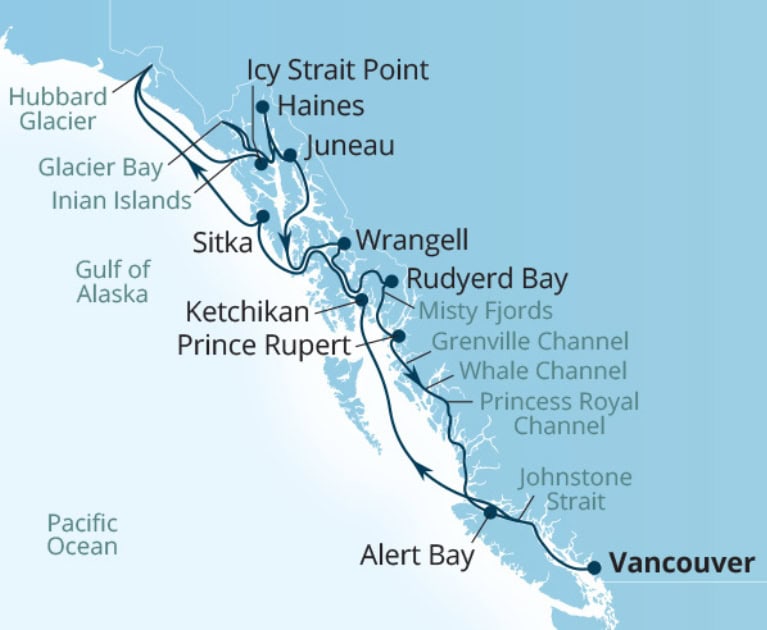
Discover the wild beauty of Alaska and the Inside Passage with visits to these destinations:
Vancouver is a city blessed with unparalleled natural beauty. Surrounded by mountains and water, the cityscape is a stunning juxtaposition of modern architecture against a backdrop of majestic peaks and the Pacific Ocean. Stanley Park, an urban oasis, offers a haven of lush forests, seawalls, and beaches, providing a perfect escape into nature without leaving the city. From skiing and snowboarding in the nearby mountains during the winter to hiking, biking, and kayaking in the warmer months, outdoor enthusiasts will find a paradise here. Grouse Mountain, a short drive from downtown, transforms into a winter wonderland, and the extensive network of trails in and around the city provides endless opportunities for exploration. The Seymour Narrows is a 5 kilometre stretch of the Discovery Channel north of Vancouver Island, British Columbia that is notorious for the strength of the tidal currents flowing through it. The average width of the narrows is just 750 metres. During extreme tides, the current through the narrows is subject to severe Venturi effect, resulting in an increased velocity that can reach 15 knots. For much of its modern history, there was an additional hazard in the narrows called Ripple Rock, a shallow obstruction that claimed no fewer than 119 ships and 114 lives. In 1958, after months of tunnelling and preparation, Ripple Rock was blown up in the largest commercial, non-nuclear explosion ever recorded in North America. Still, the navigation of Seymour Narrows is dependent on tidal and other conditions, and requires skill and technical accomplishment.
The Queen Charlotte Sound lies between the Queen Charlotte Strait, which winds between Vancouver Island and the British Columbia mainland in the south, and Hecate Strait, which is northward, adjacent to the Haida Gwaii Islands off the Pacific coast of British Columbia. It is a broad reach in the long shipping route called the Inside Passage threading the myriad islands stretching from Washington’s Puget Sound to Alaska.
Ketchikan is a picturesque coastal town with a colorful frontier history, standing at the southern entrance to Alaska’s famed Inside Passage. It began as a salmon cannery in 1885, built by company employee Mike Martin at the mouth of Ketchikan Creek. Once dubbed the ‘Canned Salmon Capital of the World,’ today government, commercial fishing, and tourism are its main industries. The renowned Creek Street, perched on stilts along the mouth of the creek, would bring lasting infamy to the area for the red-light district that burgeoned there during the Gold Rush. The town’s site first served as a camp for Tlingit people, and for thousands of years this has been their home. Their rich culture is being preserved to this day. A visit to Ketchikan is not complete without visiting one or all of Native American sites such as Totem Bight State Park, Potlatch Park, Saxman Native Village and the Totem Heritage Center. Together, these locations comprise the world’s largest collection of standing Native American totem poles. In the passage between Sumner Strait and Clarence Strait in Southeast Alaska’s Alexander Archipelago, midway between Price of Wales Island on the west and Zarembo Island on the east, is a small cluster of islands with a picturesque passageway between them called Snow Pass. It makes a scenic up-close route for your Seabourn ship during the transit. Decision Passage is the western end of the Sumner Strait, which runs through the Alexander Archipelago into the Pacific Ocean in Southeastern Alaska, bounded on the north by Kuiu Island and Cape Decision, the location of a 1932 lighthouse. This is the route your ship takes when coming from or going to the colourful historic community of Sitka on the west coast of Baranof Island, which was originally the Russian fortress town of New Archangel.
Story and soul await in the history and lush scenery of this remote city on Baranof Island. As the oldest city in Alaska, only accessible by air and sea, Sitka is the perfect place to relish in unbridled beauty of the Last Frontier. Nicknamed the “Paris of the Pacific” for the growing wealth acquired during its logging, gold, and fur trade booms, Sitka was sold to the United States by Russia in 1867. Picturesque remnants of Russia’s architectural influence are still present; one of the most intriguing structures is the Cathedral of Saint Michael, built in 1848 to honour a Russian Orthodox bishop. The mix of Tlingit tradition runs heavily through Sitka’s streets as well, making for a unique blend of history and culture. From salmon fishing, hikes in the Tongass rainforest, exploring the coastline by private vessel, or even a round of golf in some of the toughest and most beautiful holes in all of Alaska… one visit to Sitka is never enough because of the infinite ways to connect with its culture, wildlife, and people.
Yakutat Bay is 13 kilometres wide at its entry, and cuts from the Gulf of Alaska into Disenchantment Bay, the entryway to the huge Hubbard Glacier, North America’s largest tidewater glacier. As the bay narrows and the shorelines draw closer, the 400-foot face of the glacier exerts a luminous, ghostly presence, often from as much as 48 kilometres away. More and more floating ice dimples the surface of the water, and seals bob up and disappear again. The chilled air from the glacier flows in a downdraft of cold that gives rise to mists and gray clouds, through which the vivid blue of the ice wall shimmers. It is an impressive sight of nature’s immense raw workplace, shaping the earth itself as part of an endless cycle of water from the sea evaporating to the sky, falling as snow on the heights and inching over centuries back again to the sea.
As the gatekeepers to the northern entrance of the fabled Inside Passage, the remote Inian Islands stand between Cross Sound and Icy Strait, exposed to the high energy seas of the Pacific Ocean. Tidal currents surging through the narrow channels separating the islands can be severe. Nicknames like ‘The Laundry Chute’ justify their notorious reputations. For millennia, Tlingit people came here to hunt and fish in the rich bounty that these waters provided. Today, the Inian Islands Institute, located within the islands, provides access to the abundant and protected waters for scientific research. Sitka black-tailed deer and brown bears frequent their rugged and rocky shores, while sea lions fill their stomachs with salmon before hauling out to rest on the many rocky outcrops making up this island group. Sea otters, bald eagles, and humpback whales frequent the area in great numbers during the summer months. The Inian Islands were named by William Healey Dall, one of Alaska’s earliest scientific explorers, in 1879. Icy Strait Point is a unique community on Chichagof Island near the entry to Glacier Bay National Park. It was created and is owned by a corporation of over 1,300 Native Americans of various local Tlingit tribes, for the purpose of offering visitors an enjoyable, educational experience of Alaska’s native cultures, as well as the human and natural history of the region. Your tender will dock at the historic 1912 salmon canning facility, which today is a museum. The surrounding grounds offer cultural performances, Native American-owned shops and galleries, restaurants and a variety of tours and excursions for every interest from sport fishing to whale watching, guided nature walks and excursions to view bears and other wildlife, ATV tours and even a zipline adventure that is said to be the longest and highest in North America. The small village of Hoonah is just over a mile away, and can be reached either by walking or on a shuttle. It also has shops and eateries, as well as a totem-carving enterprise run by the corporation. The Huna Totem Corporation maintains complete control of the content and access to the community, which has won a number of prestigious awards for its sustainable approach to exploiting the natural and historical heritage of Alaska and its native peoples for their benefit.
Tucked in along the shores of the longest fjord in North America and surrounded by breathtaking scenery, Haines is an authentic Alaskan experience. It is an eclectic community and a truly hidden gem. Its rich culture shines brightly during the annual state fair that draws people from all over Alaska. Haines is home to the largest concentration of bald eagles on earth, and grizzly bears gorge themselves on spawning salmon in its rivers. It was originally named Dteshuh, which means ‘end of the trail’ in the language of the Chilkat natives, who used to portage across the peninsula to Chilkat Inlet as a shortcut to their trade route to the interior. The first Europeans arrived in 1879 to build a school and a Presbyterian mission. In time, the mission was renamed Haines in honor of Francina E. Haines, the chairwoman of the committee that raised funds for its construction. Haines grew dramatically during the 1899 Klondike gold rush in the Yukon, supplying prospectors with food and equipment. Lynn Canal is a 145-kilometre long inlet into Alaska’s coast running from the Chilkat River in the north to the Chatham Strait and Stephens Passage in the south. Because it connects the towns of Skagway and Haines to Juneau and the rest of the Inside Passage, it is an important shipping lane for ferries, cargo and cruise ships, and was a crucial passageway to the Klondike gold fields during the Gold Rush. It was discovered by Joseph Whidbey in 1794 and named by George Vancouver after his birthplace, King’s Lynn in Norfolk, England. More than 609 metres in depth, it is one of the deepest and longest fjords in the world, and the deepest in North America outside Greenland.
Juneau, Alaska’s capital, is accessible only by air and sea, due to the rugged mountain terrain that surrounds the city. It has been a world-class travel destination since the early 1900’s. The city has plenty to offer the outdoor adventurer. You may choose to explore on foot along the Perseverance Trail or around Mendenhall Glacier, or board one of the many local whale-watching boats, or view the mountains and extensive glaciers of the Juneau Icefield from a helicopter. Although founded by Alaskan pioneers, this area was in use for thousands of years by the Tlingit people and was originally settled by the Auke tribe, taking advantage of the abundant food and natural resources provided by the land and sea. Their descendants continue to gather clams, gumboot chitons, grass and sea urchins to this day. Originally named Harrisburg in 1880, after the gold prospector Richard Harris, the name was later changed to honour his partner Joe Juneau.
Designated as an International World Heritage Site in 1992, Glacier Bay is also a National Monument, a National Park and a designated Biosphere Reserve. Over millennia, Glacier Bay has experienced many major advances of its glaciers. When first surveyed in 1794 by a team under the command of British captain George Vancouver on HMS Discovery, its vast glaciers extended well beyond present-day margins of the bay. Temperate, coniferous rainforest dominates its southern shores. Black and brown bears, wolves, moose, eagles and ravens all go about their daily routines, while harbour seals and whales frolic within the bay waters. Glacier Bay has two major arms, East and West, and over fifty named glaciers, some of which push forward at three to six feet per day. Combined with Wrangell St. Elias National Park and Canada’s Kluane National Park and Alsek-Tatshenshini Park, Glacier Bay encompasses the largest protected wilderness area on earth. This is a truly a place of awe-inspiring beauty and an icon of wild Alaska. The scenic, 240-kilometre long Chatham Strait runs from the confluence of Icy Strait and the Lynn Canal to the open sea, through the Alexander Archipelago in Southeast Alaska. Varying between 5 and 16 kilometres wide, it is bounded on the east by Admiralty and Kulu Islands and in the west by Chichagof and Baranof Islands. The strait has had many names since its original Tlingit one, being designated on maps by Spanish, French and British explorers as well as different bands of fur traders before George Vancouver formally named it in 1794 in honor of William Pitt, the first Earl of Chatham.
Decision Passage is the western end of the Sumner Strait, which runs through the Alexander Archipelago into the Pacific Ocean in Southeastern Alaska, bounded on the north by Kuiu Island and Cape Decision, the location of a 1932 lighthouse. This is the route your ship takes when coming from or going to the colourful historic community of Sitka on the west coast of Baranof Island, which was originally the Russian fortress town of New Archangel. One of the thousands of islands of the Alexander Archipelago, Wrangell Island sits at the heart of the Tongass National Rain Forest and receives approximately 203 cm of rain per year. The city of Wrangell, a true Alaskan frontier town, sits at the northern end of the island, a short distance from the mouth of the mighty Stikine River. The history of Wrangell is deeply rooted in the Tlingit people, the fur trade and the gold rush. The Stikine River trade route brought the Tlingit people here thousands of years ago, evidenced by some forty petroglyphs at Petroglyph Beach State Historic Site and Totem Park. The Stikine River, Shakes Glacier and Anan Creek Bear Observatory are highlights in the region. Anan Creek boasts the largest pink salmon run of the Inside Passage, attracting brown and black bears in great numbers. Wrangell was named for Ferdinand Petrovich Wrangel, a Russian explorer and administrator of the Russian-America Company during the mid-1800’s. Stikine Strait is a picturesque channel in the Alexander Archipelago of Alaska between Zarembo Island and Woronkofski and Etolin Islands near the mouth of the Stikine River south of Wrangell. It first appears on an 1848 Russian chart as Stakhin Strait and has been spelled variously on many charts since that time.
The 174-kilometre Behm Canal runs from the Clarence Strait through the Alexander Archipelago of Southeast Alaska, and into the channel separating Revillagigedo Island from the mainland. It forms part Inside Passage on the route between Ketchikan and the Misty Fjords National Monument. The canal was named by George Vancouver during his surveying expedition in 1793, in honour of Magnus von Behm, who had been governor of Kamchatka in the Russian Far East when Vancouver called at Petropavlovsk with Captain Cook’s expedition following the Cook’s murder in Hawaii. Scottish-American naturalist John Muir compared the 930,000 hectare Misty Fjords National Monument to his favorite place in America, Yosemite National Park. Often shrouded in mist, Misty Fjords is a true wilderness. Its vertical granite cliffs, which reach 900 metres above sea level, descend another 300 metres below the water’s surface. Carved by glaciers and covered in a green carpet of mosses and lichens, Misty Fjords receives more than 381 cm of rain per year. Western hemlock, Sitka spruce, and western red cedar dominate the prolific vegetation along its shore. Mountain goats, brown and black bears, coastal wolves, sea lions, bald eagles, ravens, Dall’s porpoises, orca and humpback whales can be spotted along its shorelines and throughout its waters. Long before the arrival of John Muir, the Tlingit people lived and moved throughout this region, surviving on what the land provided. Evidence of their historic and ongoing presence is recorded in the many pictographs found along the shores of Misty Fjords.
Prince Rupert, set amongst the coastal mountains, is the jumping-off point for travellers joining the coastal ferries to Haida Gwaii, Vancouver or north to Alaska. Highlights include the quaint Cow Bay with its shops and restaurants, the Museum of Northern British Columbia, the totem carving house or the stunning sunken gardens. Prince Rupert certainly has abundant wildlife. Whether you join a local boat for whale-watching, hike along the Butze Rapids or take a scenic flight, you are sure to be pleased. The region is home to the highest concentration of grizzly bears in North America. The Khutzeymateen Grizzly Bear Sanctuary, established in 1994, was the first area in Canada to be protected specifically for grizzlies and their habitat. Founded in 1910, the town was named for Prince Rupert, who was a governor of the Hudson’s Bay Company in 1670. Prince Rupert is the northern terminus of the Canadian National Railway and an important port for goods moving towards Alaska.
Grenville Channel is a long, well-protected channel along the northern British Columbia coast between the large Pitt Island and the mainland. It is an important shipping lane, and you are likely to see ships of many different types and sizes as you pass through. The shores are mountainous on both sides, with two notable peaks about halfway through, Mt. Batchellor on the east side and Mt. Saunders on Pitt Island to the west. There are a number of Indian Reserves and Marine Parks in the mountains and narrow waterways off the channel. Whale Channel is a picturesque waterway separating Gil Island from Princess Royal Island in British Columbia’s Inside Passage. Surrounded by snow-capped mountain ranges and teeming with marine life, It is a diversion from the main shipping lane, located roughly halfway between Prince Rupert and the First Nations village of Klemtu. The Princess Royal Channel separates the largest island along British Columbia’s coast from the mainland. It is located roughly halfway between Bella Bella in the south and Prince Rupert in the north, in one of the province’s most remote areas. Princess Royal island was named in 1788 by Captain Charles Duncan, in honor of his ship, the Princess Royal. The island is uninhabited, although there are two small villages in the channel, the First Nations community of Klemtu on Swindle Island and Hartley Bay on the mainland. Wildlife, by contrast, is plentiful, including Kermode, black and grizzly bears, deer, wolves and foxes. Golden and bald eagles nest in the region, as well as the endangered marbled murrelet. In the waters, there are abundant salmon, elephant seals, whales, orcas and dolphins.
Located on the now-dormant Alert Bay volcanic belt, Cormorant Island is host to Vancouver Island’s oldest northern community, the small town of Alert Bay. It is located in the traditional territory of the Kwakwaka’wakw First Nation and today is a blend of both aboriginal and pioneer culture. A walk along the shores of this tiny 1.8 square kilometres island will amaze you with its history, spectacular views and abundant wildlife. Remnants of its former fish-salting plant from the 1800’s remain along the harbor. The U’mista Cultural Centre is Canada’s longest-running First Nations museum and home to the famed Potlach Collection. This collection of ceremonial regalia was confiscated for preservation by Canadian authorities in 1922, and finally returned to the community during the 1980’s. Seabirds, humpback, orca, and gray whales, sea lions and white-sided dolphins are all present in the surrounding waters. Alert Bay was named in 1860 for the Royal Navy ship HMS Alert which conducted survey operations in and around the region. Johnstone Strait is a well-protected shipping route passing 110 kilometres along the northeast shore of Vancouver Island between the island and the mainland of British Columbia. The strait leads from the broad Georgia Strait through a narrow channel called Discovery Passage. The strait was named by Vancouver in 1792 for James Johnstone, the master of one of his tenders during the survey expedition that revealed Vancouver Island to be an island. There are no cities or towns on the strait. The Johnstone Strait is the summer range of a large pod of seasonally resident orcas which are frequently seen in the area. The Seymour Narrows is a 5 kilometre stretch of the Discovery Channel north of Vancouver Island, British Columbia that is notorious for the strength of the tidal currents flowing through it. The average width of the narrows is just 750 metres. During extreme tides, the current through the narrows is subject to severe Venturi effect, resulting in an increased velocity that can reach 15 knots. For much of its modern history, there was an additional hazard in the narrows called Ripple Rock, a shallow obstruction that claimed no fewer than 119 ships and 114 lives. In 1958, after months of tunneling and preparation, Ripple Rock was blown up in the largest commercial, non-nuclear explosion ever recorded in North America. Still, the navigation of Seymour Narrows is dependent on tidal and other conditions, and requires skill and technical accomplishment.
Vancouver’s multicultural population has resulted in a rich tapestry of cultures and cuisines. The city’s diverse neighbourhoods showcase a vibrant mix of art, music, and culinary experiences. Food lovers can indulge in a world of flavors, from Asian street food to Pacific Northwest seafood, making Vancouver a true epicentre of cultural fusion and gastronomic delights.
Find a personal travel manager to make an enquiry
Product ID 158431: Advertised pricing is per person, Australian Dollars, based on the lead category (unless specified otherwise) in twin-share occupancy inclusive of all discounts, taxes, fees, and port expenses (which are subject to change). Supplements apply to other stateroom categories. Valid for new bookings only and offers are not combinable with any other promotion or pricing. Whilst the information is correct at the time of publication (20/04/2026), prices are capacity controlled, subject to availability, and may be withdrawn at any time without notice due to fluctuations in charges, taxes, and currency. Some categories are based on GTY cabins and by selecting this ‘guarantee’ grade, this means your stateroom number will be allocated at the discretion of the cruise line either close to the date of the sailing or on the day itself. You will be guaranteed a minimum standard of cabin (indicated by the cabin grade booked). We are not able to accept any special requests regarding the position of the cabin, cabin facilities or bed configuration. Once your ‘Guarantee’ stateroom has been allocated to you, we are unable to accept any changes requested by you. Any land accommodation is subject to change and availability. Prices may not include mandatory resort fees. If the selected accommodation is unavailable, we will offer an alternate option of similar grade. Any variance in cost will be added to your invoice. #Air Credit: Offer provides AUD$1,500 per person air credit of airfares. Air credits are not transferable, non-refundable, not redeemable for cash. Any unused value will be forfeited. Airfares must be booked through your personal travel manager at TravelManagers Australia and is valid for this package offer only. If the required airfare is greater than AUD$1,500 per person, air surcharges will apply. Further conditions may apply. Your personal travel manager may charge additional service fees. Please view the TravelManagers general terms and conditions here and contact your personal travel manager for more details. Further conditions may apply. To be read in conjunction with Seabourn’s terms and conditions which passengers will be bound by.
TravelManagers respects and honours the Traditional Custodians of the land and pay our respects to their Elders past, present and future. We acknowledge the stories, traditions and culture of Aboriginal and Torres Strait Islander peoples on the lands where we work and gather, and those we visit.