
Plus enjoy Princess Cruises® Princess Plus:
Cruise the Mediterranean and Greek Isles on this 11-night cruise with stops at these destinations:
Tucked in the country’s northeast corner on the Adriatic Sea and once the flourishing port of the Austro-Hungarian Empire, Trieste became a largely forgotten borderland after World War I. But today, those who visit find a blend of cultures and languages of Europe, with a rich literary legacy – a city that’s lured great authors from Ranier Maria Rilke to James Joyce. Waves from the Adriatic lap its elegant promenades. It lies below the Karst, limestone cliffs that are a popular destination for nature lovers and where vineyards produce wines that taste of sea and stone. Legend has it Jason and the Argonauts – with the golden fleece – sailed in from an underground river. A well-preserved Roman theater, that once seated up to 6,000 spectators, is testimony that in antiquity, this was a thriving city. Gilded mosaics in San Giusto Cathedral are evidence of Byzantine influence. Trieste offers endless opportunity for exploration not only in the town and surroundings, but also to neighboring Slovenia and not so far distant Venice.
Pine-clad hills, secluded coves, beaches – Split and the Dalmatian Riviera have been premier destinations on the Adriatic since the days of the Roman emperors. In fact, medieval Split was built within and around the palace complex built for the emperor Diocletian in his retirement. (The complex included both a villa and a castrum – a Roman camp capable of garrisoning three legions!) The charms that soothed an emperor are still evident today. The Dalmatian Riviera offers the traveler a heady blend of natural beauty and fascinating cultural sites.Diocletian abdicated in 305 A.D. During his reign, the emperor ruthlessly persecuted Christians. Ironically Split’s St Dominius’ Cathedral occupies his mausoleum.
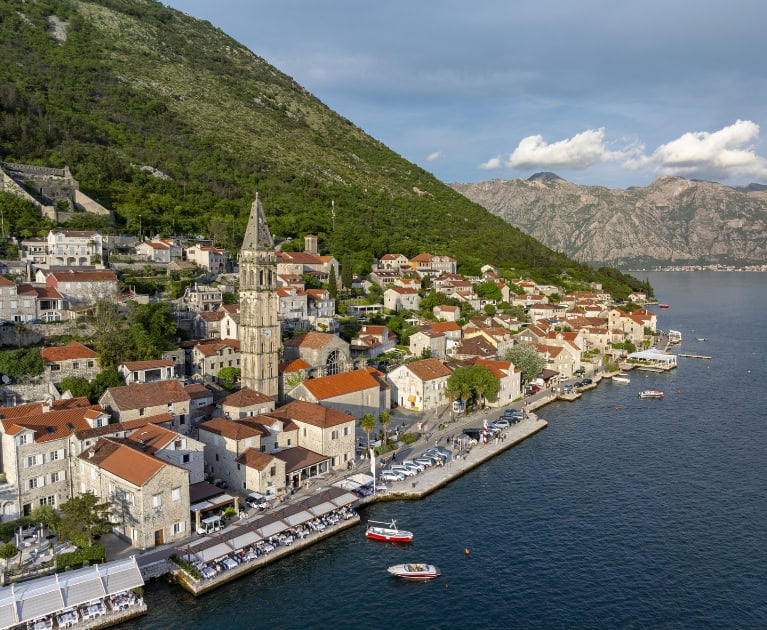
Kotor lies at the head of Boka Bay. Bordered by towering limestone cliffs, the winding bay is actually Southern Europe’s longest and most dramatic fjord. The port itself is a medieval gem: its narrow, asymmetrical streets are lined with ancient stone houses, old palaces, and churches dating from the 12th century. Kotor is also your gateway to the cultural and scenic wonders of Montenegro, from the old royal capital at Cetinje to the marshes and wildlife of Lake Skadar National Park. Kotor is renowned for its nightlife: the streets of the old port are lined with pubs, taverns and cafés. The city is also host to a renowned summer carnival. Kotor is an anchorage port. Passengers transfer to shore via ship’s tender.
The lush and verdant island of Corfu lies in the Ionian Sea, midway between Greece and Italy. The island has a long and colourful history. First colonised by the city-state of Corinth, Corfu has been ruled by the Romans, the Venetians, the French and the English. Corfu Town boasts fortresses bearing the insignia of the Venetian Republic, an esplanade lavishly planted by the French during the Napoleonic Wars, and an English cricket pitch. The island also offers some of the finest coastal scenery in the entire Mediterranean. Corfu’s old town is a mixture of the medieval and the modern. The Esplanade, planted with palms and eucalyptus by the French, leads to the English cricket pitch.
Perched on the west coast of the Peloponnesus, Greece’s largest peninsula, this sleepy fishing village of some 300 souls is your gateway to Olympia, site of the original Olympic Games. Held every four years between 776 B.C. and 393 A.D., when the Emperor Theodosius banned pagan festivals, the Olympic Games celebrated the ideal harmony of mind and body. Every four years, the sacred flame of Altis is rekindled to light the torch for the Modern Games. Olympia’s temples were destroyed after the games were banned. An earthquake in the 6th century compounded the destruction, and floods buried the site. Excavation of the ruins began in 1875, and Olympia was declared a National Park in 1976.
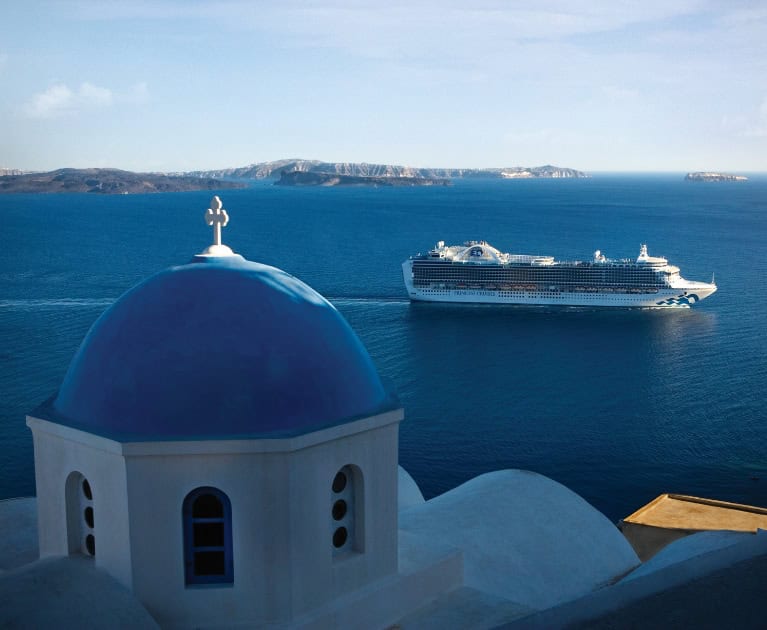
Did the catastrophic volcanic eruption that ravaged Santorini circa 1600 B.C. destroy Crete’s ancient Minoan civilisation – and give birth to the myth of Atlantis? In 1967, archaeologists on Santorini unearthed the remains of a Bronze Age city that may have been home to as many as 30,000 people. Whether the Lost Continent of Atlantis is rooted in myth or reality, an undisputed fact remains. The eruption created a caldera – and one of the most dramatic land and seascapes in the entire Mediterranean. On Santorini, whitewashed buildings cling to vertiginous cliffs that plunge to a turquoise sea. Part of the Cyclades Archipelago, the three-island group of Santorini, Thirasia and uninhabited Aspronisi present the traveler with unforgettable vistas.The island has had a number of names throughout history – from Strongyle or “Round” to Thera in honor of an ancient hero. Santorini is more recent and stems from the island church dedicated to St. Irene – Santa Rini to foreign sailors. Note: Santorini is an anchorage port: passengers transfer to shore via shore tender.
Weaving a tapestry of awe and wonder, Chania is a centuries-old mix of Minoan myths, well-preserved Venetian mansions, a mesmerising Old Town complete with labyrinthine passageways, and atmospheric Kastelli Hill, once the site of a Roman acropolis. But Chania may be best known as the gateway to the breathtaking 4,000 year-old Minoan ruins at Knossos, home of the legendary King Minos and the part man and part bull known creature as the Minotaur. And around every corner of this idyllic area you’ll find picturesque villages, breathtaking views and architectural wonders that will remain with you for a lifetime.
The largest and arguably the most beautiful of the 12 islands forming the Dodecanese, Rhodes has long played a major role in history. Lying just 12 miles off the coast of Turkey, the island straddles the sea-lanes linking Egypt, Southern Europe and the Holy Land. Rhodes Town bears witness to that long history. The ancient city features a classical stadium and the ruins of the Temple of Apollo. The “old” city is a walled town with medieval buildings and streets harking back to the days of the Crusades. The new town is a Mecca of luxury resorts lining the island’s picturesque Mandaraki Harbor. The Colossus of Rhodes, one of the Seven Wonders of the Ancient World, is reputed to have once stood guard over the harbour. Today, the bronze statues of a stag and doe top the two columns marking the harbour entrance.
Limassol offers everything a traveller desires in a Mediterranean destination. The second-largest city on Cyprus is surrounded by a wealth of historic sites ranging from the Greco-Roman ruins at Paphos and Curium to Crusader castles. The Troodos Mountains feature quaint villages, dramatic scenery and cool, dense pine forests. The island’s capital of Nicosia is a mere hour’s drive from the port. And for the casual visitor, Limassol offers its own medieval castle, a superb Public Garden, excellent beaches and that exhilarating Mediterranean light. Cyprus lies at the crossroads of the Eastern Mediterranean. Over centuries, every major power has contended for control of the island. Today, the Republic of Cyprus is a member of the European Union.
From the port of Kusadasi on Turkey’s Anatolian Coast, one travels into the past. Nearby stand the ruins of ancient Ephesus, a major site of archeological excavation. The city was once a Roman provincial capital and trading centre. Ephesus is also home to several of Christendom’s holiest sites. St. Paul preached at the Great Theater and the ruins of Ephesus’ Basilica cover the tomb of Christ’s most beloved disciple, St. John the Apostle. In Kusadasi, whitewashed stone houses rise in tiers behind the market district. The palm-lined esplanade is the center of town life, with thousands of merchants offering wares to rival the Grand Bazaar in Istanbul.
The past maintains a vibrant presence in the cradle of Western civilization. Atop the Acropolis, the serene Parthenon sails above the commotion of the modern city. The tragedies of Aeschylus, Sophocles, and Euripides were performed in the Theater of Dionysus at the foot of the Acropolis. On Pnyx Hill, citizens of a fledgling democracy gathered to cast their votes on Athens’ destiny. Then there is the hustle and bustle of the modern city, a metropolis of 4.5 million that spreads out from the foot of Mt. Lycabettus and across the plain. Packed with busy shops and lively tavernas, modern Athens is a colourful counterpoint to classical Greece. Piraeus is the port city for Athens and has been Athens’ port of entry for over two millennia.
Find a personal travel manager to make an enquiry
Advertised prices are per person twin share, correct at time of publication and are subject to availability and change and can be withdrawn or amended at any time without notification due to fluctuations in charges, taxes and currency. Fares are cruise only, per person (‘PP’) in AUD, in complete twin stateroom as specified, based on lead categories at publication date 10 March 2026 inclusive of discounts. Offer starts 11 June 2026 00:00 AEDT and ends 11 July 2026 23:59 AEST. Valid for new bookings only. Not combinable with other offers. Supplements apply for higher room grades, categories and fare types. Some staterooms have obstructed views. Onboard currency varies – refer to https://www.princess.com/en-au/faq/onboard-experience# for details. Princess Plus fare applies to the first 2 guests in the stateroom and includes the cruise fare packaged with the Plus Beverage Package, 1 device Wi-Fi and more. Inclusions are subject to change – see Fare Terms and Conditions. Princess Premier fare is valid for the first two guests in the stateroom and includes the cruise fare packaged with the Premier Beverage Package, 4 device Wi-Fi and more. Inclusions are subject to change – see Fare Terms and Conditions. First and second guests in a stateroom must be booked on the same fare type. Princess Plus and Princess Premier must be booked for the entire duration of the voyage. ^Onboard Spending Money (‘OBS’) Offer (‘OBS Offer’) is per room, in AUD and applied to the first 2 guests in the room only. OBS expires at the conclusion of your cruise, is not transferable, not refundable, not redeemable for cash and cannot be used in the casino or medical centre). Receive bonus $100 OBS per stateroom on selected Princess cruises of 7 nights or longer. Cruise Sale benefits are only available for new bookings made between 11June and 11July. OBS Currency varies between voyages. #Pay only 50% of the standard deposit. All travel is subject to Princess Cruises Passage Contract at https://www.princess.com/en-au/legal/passage-contract which guests are bound by. Cruise itineraries and onboard offerings are not guaranteed. Your personal travel manager may charge additional service fees. Other conditions apply. Please view the TravelManagers general terms and conditions here and contact your personal travel manager for more details.
TravelManagers respects and honours the Traditional Custodians of the land and pay our respects to their Elders past, present and future. We acknowledge the stories, traditions and culture of Aboriginal and Torres Strait Islander peoples on the lands where we work and gather, and those we visit.
We improve our website, content and services by using Microsoft Clarity to see how visitors use our website. By using our site, you agree that we and Microsoft can collect and use this data. View our Privacy Policy for more details.