
Plus with Seabourn:
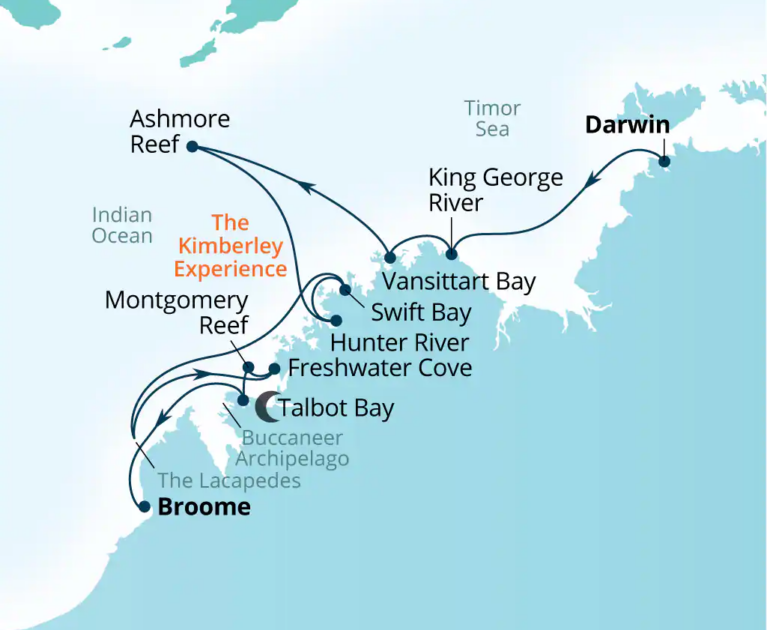
Marvel at the natural landscapes of the Kimberley as you cruise to these destinations:
Capital of the Northern Territory (NT), with an estimated population of 150,000, Darwin is home to most of the Northern Territory population. The Darwin region, like much of the Top End, experiences a tropical climate with a wet and dry season and boasts a vibrant multicultural community, where Indigenous heritage blends seamlessly with the influence of diverse international populations. Darwin’s rich history provides an incredible background for the diverse cultural and historical activities. On the 9th September 1839, HMS Beagle sailed into Darwin harbour during its survey of the area. John Clements Wickham named the region “Port Darwin” in honour of their former shipmate Charles Darwin. The city has been rebuilt almost entirely four times, following cyclones and Japanese air raids in World War II.
Explore the King George Falls, the two highest twin waterfalls in Australia at 80m/250ft in height. The river was named in 1911 by explorer Charles Conigrave after a privately funded expedition in the area. The river is named in honor of King George V. This incredible sandstone gorge is a highlight of any Kimberley Expedition.
Vansittart Bay is a small remote bay of about 30k metres squared, synonymous with the Truscott air base that was operational during the Second World War. The bay features beaches and aircraft wrecks, but the reason for our visit is the Gwion Gwion or Bradshaw art found on Jar Island. Jar Island was named by an early survey team who found clay jars on the island. These jars were the same type as those used by the Macassans who would travel down from (what today we know as) Indonesia to the top end of Australia in search of sea cucumbers. According to Aboriginal legend, the art was created by birds. It was said that these birds pecked the rocks until their beaks bled, and then created these fine paintings by using a tail feather and their own blood. The bird said responsible was known as Gwion. The Gwion Gwion art is often called Bradshaw art after Joseph Bradshaw, the first European person to record the style of painting in 1891.
Ashmore Reef Marine Park is an Australian marine park that covers the Ashmore Reef, which is located about 630 kilometres north of Broome and 110 kilometres south of the Indonesian Islands of Rote. The marine park covers an area of 583 kilomeres squares. It is one of 13 parks managed under the North West Marine Network. The marine park comprises several marine habitats, including seagrass meadows, intertidal sand flats, coral reef flats, and lagoons, and supports an important and diverse range of species, including 14 species of sea snakes, a population of dugong that may be genetically distinct, a diverse marine invertebrates fauna, and many endemic species, especially of sea snakes and mollusks. There are feeding and nesting sites for loggerhead, hawksbill, and green turtles.
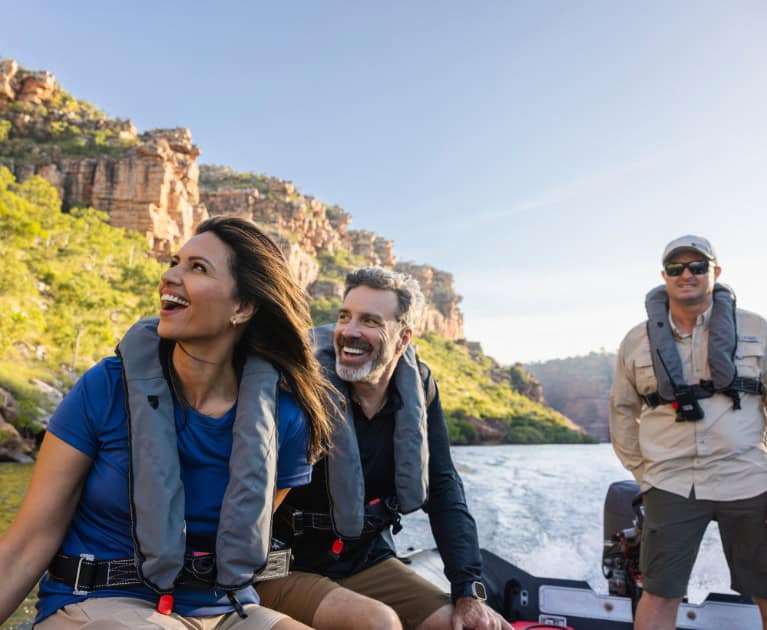
Imagine waking up to the golden hush of dawn as your ship glides through ancient sandstone gorges, the air thick with the scent of salt and adventure. This is no ordinary day— with no fixed itinerary, the day unfolds like a secret whispered by the land itself. We will search for the region’s unique wildlife—shy but nimble short-eared wallabies foraging in the cool shadows of the cliffs, and giant saltwater crocodiles silently surveying the mangroves. The Expedition Leader crafts a bespoke adventure, guided by tides, weather, and instinct. This is the Kimberley at its most raw, most real—and most unforgettable.
The Hunter River was named in 1820 by the explorer Philip Parker King aboard the Mermaid Cutter, while making charts in the area. The river was named after the surgeon on Mermaid, James Hunter. The river is home to a large mangrove estuary, that forms part of Porosus Creek (Crocodile Creek) and home to several bird species, Osprey, Brahminy Kite, and White-tailed Sea eagles. Mitchell River National Park is one of Kimberley’s two national parks. The park lies in some of the most remote and inaccessible country in Australia. It is about 350 kilometres north-east of Derby, and 270 kilometres north-west of Wyndham. The park of 115,300 hectares lies in a remote part of the Kimberley and contains some of the region’s scenic jewels. The Mitchell Plateau is one of the most scenic and biologically important areas of the State. Small patches of rainforest grow around the margins of the plateau, where they are protected from fire and receive additional moisture.
Swift Bay lies within the maze-like Bonaparte Archipelago off Western Australia’s northwest coast. This is land of the Wunambal Gaambera people, whose ancestors were among the first to settle Australia. It also is home to some of the oldest and most abundant rock art in the world. When Aboriginal marine voyagers first arrived in the remote Kimberley from Africa upward of 50,000 years ago, they started decorating the fractured sandstone walls with paintings. Some of the finest adorn the rock shelters, caves and overhangs found around Swift Bay, which early Australian explorer Phillip Parker King named in honor of Jonathon Swift, author of Gulliver’s Travels. The T-shaped bay features massive galleries with both Wandjina and Gwion Gwion art, offering a unique opportunity to compare these two distinctive styles. Wandjina spirit images, created about 3,500 years ago, are wide-eyed, richly detailed, and often appear alongside fish, turtles, crocodiles and other creatures. The much older Gwion Gwion paintings are unique to the Kimberley region and feature elongated humanlike figures, some of which are hunting, dancing, and even sailing in ships.
The Lacepede Islands are a remote and pristine region, located in the Kimberley region of Western Australia. It is renowned for its stunning natural beauty and abundant wildlife. The islands feature rugged coastlines, white sandy beaches, and crystal-clear waters, making it a haven for nature enthusiasts and birdwatchers. Lacepede Islands are particularly famous for nesting seabirds, including the brown booby and the roseate tern. The islands are also an important site for marine life, with coral reefs and diverse fish species in its surrounding waters. Visitors can enjoy snorkeling, wildlife observation, and the untouched wilderness of this isolated and unspoiled island group. It offers a unique opportunity to experience the unspoiled beauty of the Kimberley coastline.
Wiggingarra Butt Butt (Freshwater Cove) lies on the mainland adjacent to Montgomery Reef. Named appropriately, as fresh water pours from out the ground all year round, making this an ideal area for a traditional camp. The area is managed in partnership with the Damibmangari traditional owners, who have strong cultural connections to the Lalang-garram / Camden Sound Marine Park and Montgomery Islands. Montgomery Reef is a reef off the Kimberley coast of Western Australia. It is situated at the southwestern Camden Sound end of and surrounds Yawajaba (Montgomery) Island. With its total area of 400 square kilometres it is the world’s largest inshore reef. The reef and island were named by Philip Parker King, the first European to sight the island, aboard the HMS Mermaid while exploring the area in 1818. King named the island after the ship’s surgeon, Andrew Montgomery. When the tide is out, vast lagoons, sandstone islets, and a central mangrove island are revealed. The outward movement of the tide forms a torrent of water, creating a river cutting through the reef and hundreds of cascading waterfalls. At low tide, more than 4 metres of reef can be exposed. While the tide is going out, the waterfalls attract migratory wading birds, feeding turtles manta rays, black tipped reef sharks and dugongs.
Talbot Bay is the site of the Horizontal Waterfalls, which lie about 32 kilometres to the east of Cockatoo Island in the Buccaneer Archipelago. The effect of the waterfalls is created by the rapid tidal fall on the ocean-side of gaps in the sandstone cliffs. Waters on the inland side of the gaps cannot escape fast enough and so a ‘’horizontal waterfall’’ is created by the cascades, with water levels differing sometimes by several meters on either side of the gaps. The gaps themselves were once layers of siltstone in the strata of the sedimentary rock. It is through these gaps that tide movements push sea water to create the Horizontal Waterfalls.
Perched on the Northwest edge of Western Australia, Broome was once an isolated gem, reachable only by a rugged dirt road until the mid-1980s. The town is nestled on a narrow peninsula, encircled by the crystal-clear sapphire waters of the Indian Ocean and the tranquil expanse of Roebuck Bay. It stands as a global haven for migratory birds, offering them a scenic stopover on their long journeys. Broome sprang to life following the discovery of the world’s most abundant pearl shell deposit. This revelation sparked a frenzy akin to a gold rush, drawing in hundreds of people lured by the promise of precious treasures. Despite a downturn in the pearl industry during the last century, the allure of Broome’s natural splendour and serene ambiance held many captives, anchoring them to this coastal sanctuary. Today, Broome boasts a unique architectural landscape, a testament to its diverse history. A blend of colonial buildings, old mission houses, churches, and the huts of former pearling masters share the streets with more modern homes. These structures collectively echo a distinctive style that took root over eighty years ago.
Find a personal travel manager to make an enquiry
Product ID 158367: Advertised pricing is per person, Australian Dollars, based on the lead category (unless specified otherwise) in twin-share occupancy inclusive of all discounts, taxes, fees, and port expenses (which are subject to change). Supplements apply to other stateroom categories. Valid for new bookings only and offers are not combinable with any other promotion or pricing. Whilst the information is correct at the time of publication (26/03/2026), prices are capacity controlled, subject to availability, and may be withdrawn at any time without notice due to fluctuations in charges, taxes, and currency. Some categories are based on GTY cabins and by selecting this ‘guarantee’ grade, this means your stateroom number will be allocated at the discretion of the cruise line either close to the date of the sailing or on the day itself. You will be guaranteed a minimum standard of cabin (indicated by the cabin grade booked). We are not able to accept any special requests regarding the position of the cabin, cabin facilities or bed configuration. Once your ‘Guarantee’ stateroom has been allocated to you, we are unable to accept any changes requested by you. Any land accommodation is subject to change and availability. Prices may not include mandatory resort fees. If the selected accommodation is unavailable, we will offer an alternate option of similar grade. Any variance in cost will be added to your invoice. #Bonus travel credit: Offer provides AUD$500 per person travel credit valid to use for added travel components such as additional night’s accommodation, accommodation room upgrades, transfers etc. Travel credits are not transferable, non-refundable, not redeemable for cash. Any unused value will be forfeited. Travel credit is applied to the first 2 guests in the stateroom only. Added travel components must be booked through your personal travel manager at TravelManagers Australia and is valid for this package offer only. If the added travel component is greater than AUD$500 per person, surcharges will apply. Further conditions may apply. Your personal travel manager may charge additional service fees. Please view the TravelManagers general terms and conditions here and contact your personal travel manager for more details. Further conditions may apply. To be read in conjunction with Seabourn’s terms and conditions which passengers will be bound by.
TravelManagers respects and honours the Traditional Custodians of the land and pay our respects to their Elders past, present and future. We acknowledge the stories, traditions and culture of Aboriginal and Torres Strait Islander peoples on the lands where we work and gather, and those we visit.