
Fly for free^
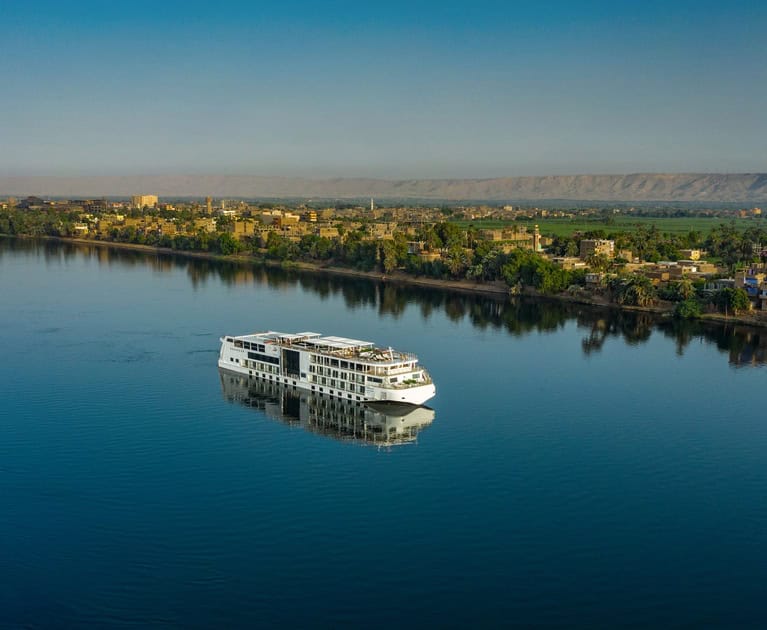
Discover the rich history and secrets of the Nile on this 11-night journey with stops at these destinations:
Arrive and check in to your hotel. It has been said of Egypt’s exhilarating capital, “He who has not seen Cairo has not seen the world.” Certainly, the heart of the nation beats with an unbridled passion in this city made prosperous over millennia as a stopover for Sahara caravans on trade routes to Byzantium. Amid the stimulating strum, the insistent beauty of everyday life reigns here, with the serene Nile sliding through like an entrancing serpent. Cairo’s very age mesmerises; its monuments have stood here for more than 5,000 years.
For centuries, Cairo has played a central role in religious and cultural developments in Egypt. Today, the city is home to the only Wonder of the Ancient World still intact—the Great Pyramid of Giza. And the city’s historic district, Old Cairo, boasts the world’s highest concentration of Islamic architecture. In addition to these monuments, Cairo has been making efforts as a member of the UNESCO Creative City of Crafts and Folk Art to preserve its traditional craftwork heritage including glassblowing, coppersmithing, pottery, ceramics and jewellery.
A captivating world that has withstood the tests of time unfolds beyond the medieval walls enclosing Old Cairo. Muizz Street, named for the Fatimid caliph who established Cairo as Egypt’s capital in 969, was the city’s main thoroughfare, running between the 11th-century city gates Bab al-Futuh and Bab Zuweila. Its splendid Islamic architecture—from elegant mosques and mausoleums to ornate palaces and former residences of Egyptian dignitaries and prominent merchants—provides a glimpse into the glory of the Fatimid dynasty and the periods that followed.
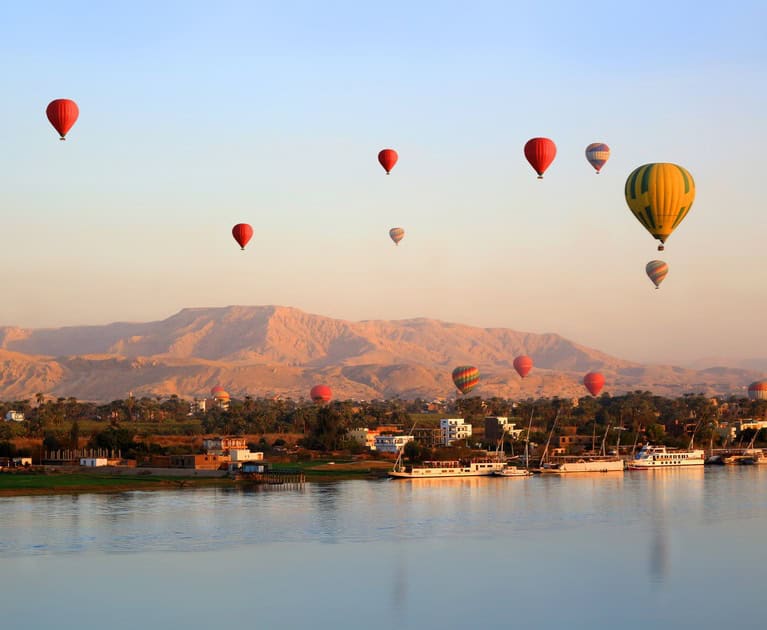
After breakfast, check out of your hotel and fly to your embarkation city. Luxor is set on the east bank of the Nile River and once served as the capital of Egypt’s New Kingdom. Today, it is a UNESCO World Heritage Site lined with beautiful colonial hotels and some of the world’s most ancient and significant ruins. Many consider this city, watched over by graceful single-sailed feluccas plying the Nile, one of the world’s great open air museums. The sprawling Temples of Luxor and Karnak on the east bank are linked by the ancient Avenue of the Sphinxes. On the west bank, in the Valley of the Kings, lie the tombs of Egypt’s great pharaohs.
Known in ancient Egypt as Caene, Qena’s situation on the banks of the Nile River has bolstered its prosperity over millennia. Merchants and travellers have long journeyed here from the Red Sea, through the valley, bringing goods from Persia and beyond. The Sheikh el-Qenawi Mosque on the main square serves as a monument to the city’s rich and all-embracing Islamic and Sufi past. Qena is mostly known as the gateway to the magnificent ruins of the Dendera Temple. Its stone gate and towering columns adorned with hieroglyphics are some of Egypt’s best-preserved structures.
Luxor lies amid what is arguably one of the world’s largest archaeological sites: Thebes, once a thriving imperial capital. In antiquity, the Nile River ran through Thebes, dividing it into a “City of the Living” and a “City of the Dead.” The former referred to the east bank (modern-day Luxor) as this was where the majority of the city’s population—and at times, Egypt’s rulers—made their home. The west bank (known today as Kurna) was designated the latter as it served as a necropolis, dotted with the lavish resting places of royalty and other nobility.
Ancient Egyptians knew Esna as Latopolis, named for the largest of the perch species that swam in the Nile’s sacred waters. Its ancient past lives on in the colourful street market overflowing with fabrics, carpets, brassware, mother-of-pearl keepsakes and more. Esna’s glorious Temple of Khnum is celebrated for its 1st-century Roman Hypostyle Hall, 24 columns topped with intricately carved floral capitals. Its walls are adorned with images of Roman emperors making offerings to Egyptian gods.
Aswan stands at what was once the northern border of ancient Nubia, a remarkable region that encompassed the land eastward from the Libyan Desert to the Red Sea and northward from central Sudan to southern Egypt. As a UNESCO Creative City of Crafts and Folk Art, present-day Aswan strives to preserve its rich heritage. Its efforts include the Aswan Folk Dance Troupe that performs internationally, the Nubian Museum showcasing Nubian daily life and craftwork, and the Aswan International Symposium of Sculpture encouraging the practice of ancient Egyptian granite stone carving.
Located at the first cataract of the Nile, a set of rapids coursing through a rocky riverbed, Aswan has long been a terminus town on the Nile. Today, the trading tradition continues in the city’s lively market near the Nile’s banks. The city also thrived due to the massive quantities of granite quarried here to build the country’s countless ancient temples, obelisks and pyramids. In the 1960s, completion of the Aswan High Dam created Lake Nasser. As the lake rose, the city became a magnet for archaeologists intent on saving ancient temples from submersion. Kom Ombo is a small town along the Nile. In the heart of one of Egypt’s fertile agricultural regions, it is surrounded by vast fields of sugarcane and corn. The village is home to a large Nubian population, many of whom were displaced when their homes were submerged by construction of the Aswan High Dam and the creation of Lake Nasser. The town’s highlight is its namesake temple, perched on a low hill overlooking the Nile. Construction was started by an Egyptian pharaoh in the 2nd century BC and completed by a Roman emperor around 30 BC.
Edfu is steeped in Egyptian legend. In this sacred place, ancient myth says that the falcon god Horus battled his uncle Seth after Seth brutally killed Horus’s father Osiris. To honour Horus, the people of Edfu built a grand temple from 237 to 57 BC, a young structure by Egyptian standards. Egyptologists have paid particular interest to its design, as it closely resembles that of much older temples. Nearby, an ancient settlement provides hints of life along the Nile, with its interesting artifacts dating as far back as 3100 BC. Home to a wealth of archaeological treasures, Luxor boasts a rich history and cultural heritage. One of the best ways to experience this is with a visit to the Luxor Museum. Located downtown, its doors have been opened to the public since 1975, when it was founded under the initiative of the Ministry of Culture of Egypt. Its thoughtfully curated collection showcases artifacts spanning from the Old Kingdom to the Mamluk sultanate. Among its most notable exhibits are those displaying the mummies of Ahmose I and Ramses I, and objects excavated from King Tutankhamen’s tomb.
After breakfast, disembark your ship and fly to your destination. Arrive and check in to your hotel. Souks (marketplaces) are central to Egypt’s social, cultural and economic traditions. A microcosm of the city, they provide a glimpse into local life, history, art, crafts and food. And in Cairo, they are in abundance, with one of its most notable lying in the historic heart of the city. Originally established as a caravansary in 1382, Khan el-Khalili is not only the largest souk in Cairo, but also the oldest in the Middle East. Its vast labyrinth of passageways is lined with bustling stalls and shops offering a wide range of goods.
Bid farewell to your fellow guests and journey home.
Find a personal travel manager to make an enquiry
Advertised prices are per person twin share, correct at time of publication and are subject to availability and change and can be withdrawn or amended at any time without notification due to fluctuations in charges, taxes and currency. Offer is not combinable with any other offer. Prices are per person, in Australian Dollars, based on double occupancy, subject to availability, includes all advertised discounts, correct at time of printing, and cannot be used in conjunction with any other offer. ^Fly Free is for economy class and up to the value of AU$2,500pp. It applies to selected 2026, 2027 and 2028 river voyages and are to be used towards flights booked by Viking on Viking’s choice of airline from major gateway cities in Australia and New Zealand. Should the applicable airfare be higher than the value of the Fly Free offer, guests are required to pay the difference. Any unused portion of the included Fly Free value is forfeited and cannot be transferred towards any other portion of the booking or any other person. Flight offers only valid if booked in conjunction with selected Viking River cruises. All offers only valid on new bookings made between 10 October 2025 and 10 November 2025 at 7pm AEST and is a strictly limited offer; conditions apply and may be withdrawn at any time unless sold out prior. For full terms and conditions visit viking.com. Itineraries subject to change. Change and cancellation fees may apply. Your personal travel manager may charge additional service fees. Other conditions apply. Please view the TravelManagers general terms and conditions here and contact your personal travel manager for more details.
TravelManagers respects and honours the Traditional Custodians of the land and pay our respects to their Elders past, present and future. We acknowledge the stories, traditions and culture of Aboriginal and Torres Strait Islander peoples on the lands where we work and gather, and those we visit.