
Seoul is one of Asia’s most energetic, fast-moving modern cities, where cutting-edge trends thrive without erasing its storied past. Straight after landing, you’ll have the option to board your first train of the trip – the airport express – or be met by private car. Then, you’ll meet your dedicated Insider guide – fluent in both English and Korean – who will welcome you to the city.
Begin your Seoul adventure by stepping back in time at Gyeongbokgung Palace, the grand former seat of the Joseon dynasty and a symbol of regal Seoul. In the northern part of the city, wander through Bukchon Hanok Village (Bukchon literally means ‘North Village’), where centuries-old hanok houses – still lived in today – co-exist with the more modern buildings of Seoul.
While in the city, you’ll have free time to explore Seoul’s distinct and up-and-coming neighbourhoods. We suggest starting with Haebangchon, a once-humble hillside district that’s now a home for rooftop bars, wine lounges, and hip eateries, all framed by sweeping city views from Namsan Mountain.
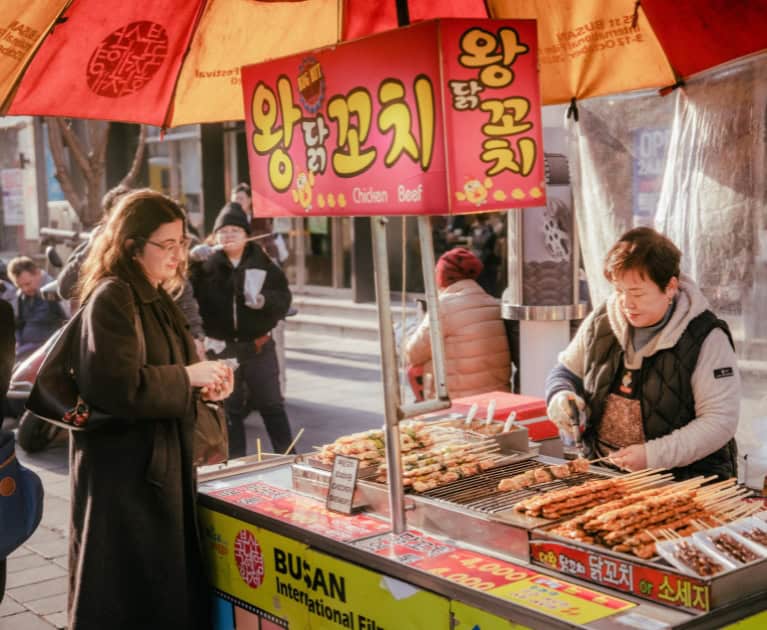
Today, it’s all aboard your first bullet train of the trip to Gangneung. But first, save some time to explore Seoul’s rail station. As the true hub of the country’s rail service, almost all KTX bullet trains terminate here – with 15 platforms and 8 tracks. And in Korea, stations double as food hubs, so perhaps pack some hotteok (sweet pancakes) or walnut cakes for the ride. Korea is proud of its railway engineering, borrowing French TGV technology and modifying their own trains to suit Korean climate and geography. So, board your train and speed eastward as Seoul’s skyscrapers fade into fields and sea-swept air. Gangneung has a slower rhythm compared with Seoul. Pine-framed lakes, open sea views, modern art, history, and coffee culture all collide to make it one of South Korea’s most exciting (and at this moment, underrated) cities. You could spend the morning pedalling the 5 km loop of peaceful Gyeongpoho Lake by bike, the scent of pine in the air and the sight of mountains reflecting in the water. Or, visit the ARTE Museum, where cascading digital light and sound art installations transform nature into a sensory-bending experience that you have to experience to understand. For a more classical take on the city, trace the steps of Korea’s Joseon past at Ojukheon House and stand beneath the vividly painted beams of the Gyeongpodae Pavilion, a lookout that has watched centuries roll by.
Take a walk along Anmok Coffee Street, a seaside stretch lined with cafes that embody the city’s cosmopolitan, coastal vibe. Or, follow the coastline to Haslla Art World, where sculptures stand out against the East Sea’s horizon. When it comes to food, Gangneung has the pick of the crop – literally. It’s known as an agricultural centre, with regional crops such as potato, rice and buckwheat growing the basis for delicious dishes like makguksu (spicy buckwheat noodles).
You’ll travel to Gyeongju via the ITX line – the only journey not on the higher speed KTX line. Despite being a touch slower (it still runs up to 165 kmph), it’s an impressive train in its own right. Carriages are painted a smart black and red, with adjustable seats, plenty of legroom and panoramic windows – ideal for taking in the sea views on one side and lush green mountains from the other, as you chug through vast rice paddies and wetlands. While you’ll see a mix of modern and traditional buildings on your route, once you arrive in Gyeongju, it’s classic all the way.
Once the capital of the Silla Kingdom, Gyeongju is often referred to as an open-air museum, with a dense concentration of ancient tombs, temples and heritage sites. Its history stretches back more than a thousand years, and much of that legacy remains visible in its streets and surrounding hills.
Over three days you’ll explore the Hwangridangil area, where traditional hanok houses now serve as cafes. Visit UNESCO-listed Bulguksa Temple and Seokguram Grotto and travel out to Yangdong Folk Village – where you’ll learn how the village set-up mirrors traditional social hierarchy.
You’ll speed down to Busan today on the superfast KTX line between Gyeongju and Busan – travelling up to 350 kmph. As South Korea’s second city and Korea’s number one trading port, Busan is a bit gritty, but is also a popular Korean weekend beach spot. Haeundae and Gwangalli beaches attract swimmers by day and market stalls by night. So, grab a beer or a convenience store slushie, and people watch as the sun goes down.
Like any good beach town, Busan has its own quirky tourist train, along the discontinued Donghae Nambu railway track. The Sky Capsule’s retro, miniature blue and yellow train cars are a cute, olde-worlde contrast to the KTX bullet train, with sweeping views out to sea at a trundling pace. Busan’s coastal path winds round east to the site of Haedong Yonggungsa, known as Korea’s ‘sea temple’. Built on the cliff edge, with a giant, golden Laughing Buddha and statues of the 12 animals of the Chinese zodiac for company, it’s worth the 108 steps to reach the inner sanctuary.
Further along to the west are the hillside lanes of Gamcheon Village, packed with bright murals, narrow stairways and cafes. Back in Busan centre, for a seafood lunch, there’s no place like Jagalchi Market, where fishing boats unload their morning catch – it’s the place to try the freshest sashimi or spicy fishcakes. And, to relax, we recommend soothing your tired legs in the SpaLand saunas and hot pools – one of the city’s expansive jjimjilbangs. If you’re feeling brave, try the body scrub (but don’t say we didn’t warn you…).
The rapid KTX bullet train takes you from Busan to Seoul journey time to a mere 2 hours 30 minutes. Travelling by car, this would take up to five hours. This is your last train ride of the tour (unless you’d like to go on further!), so take the opportunity to relax in the plush seats and watch the Korean landscapes blur by. Although a short journey, once you arrive back in Seoul you may like to stretch your legs with a walk along the Hangang River – a chance to take in the greener side to the city.
For history fans, the National Museum of Korea features exhibitions from throughout Korea’s history, like the two gilt-bronze Pensive Bodhisattva statues from the 6th and 7th centuries, inside the Room of Quiet Contemplation. But the highlight of this leg of the trip has got to be the Seoul cookery class. Guided by a local chef, you’ll make Korean classics like kimchi pancakes, beef bulgogi and bibimbap – with a cookbook and tote bag to take home as souvenirs.
Find a personal travel manager to make an enquiry
Advertised prices are per person twin share, correct at time of publication and are subject to availability and change and can be withdrawn or amended at any time without notification due to fluctuations in charges, taxes and currency. Quotes must be made between 7 May and 5 June 2026 and must be converted into deposited bookings no later than 7 days after the quote creation date. Itineraries subject to change. Change and cancellation fees may apply. Your personal travel manager may charge additional service fees. Other conditions apply. Please view the TravelManagers general terms and conditions here and contact your personal travel manager for more details.
TravelManagers respects and honours the Traditional Custodians of the land and pay our respects to their Elders past, present and future. We acknowledge the stories, traditions and culture of Aboriginal and Torres Strait Islander peoples on the lands where we work and gather, and those we visit.