
Companions fly for free^
On this 21-night adventure through the home of the Vikings, you’ll visit these destinations:
Embark your ship and settle into your stateroom. Bergen is home to the Hanseatic League’s only kontor (trading enclave) still in existence. Bryggen wharf, a row of timbered Hanseatic warehouses along a quaint quay, is a UNESCO World Heritage Site. Narrow wooden walkways are flanked by parallel rows of small, vibrantly painted buildings overlooking the picturesque Vågen Harbor. This is perhaps the most charming district of Bergen and a delight to explore, from its tight-knit community of workshops where artisans sell their wares to its cafés where freshly prepared smørbrød, or open-faced sandwiches, are on the menu.
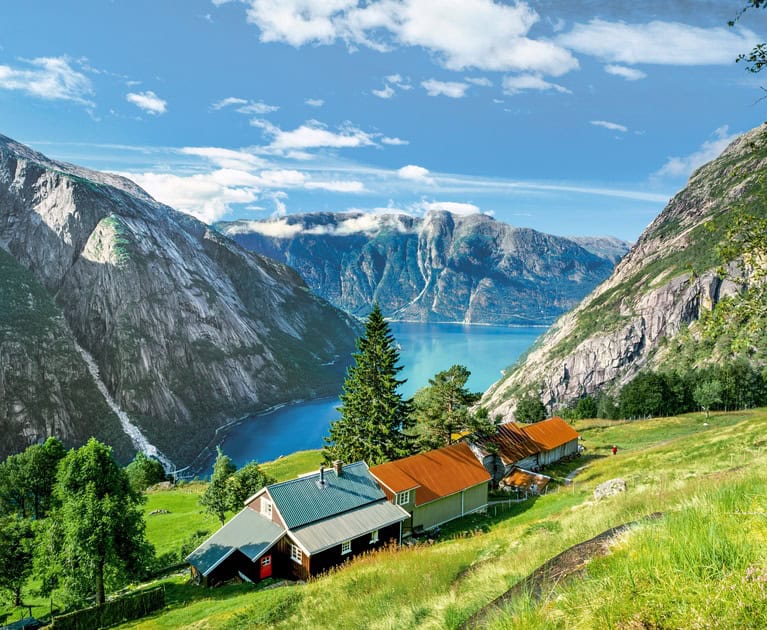
The quaint village of Eidfjord is nestled in the heart of one of Norway’s most scenic regions. From the Norwegian Sea, the waters of the expansive Hardangerfjord lead to the smaller Eidfjorden and to this charming mountain hamlet. Eidfjord embodies the Norway of every traveller’s dream, the gateway to Hardangervidda, Europe’s largest mountain plateau of soaring beauty. Wild reindeer roam here, among stunning, treeless moorlands dotted with pools, rivers, streams and the Vøringfossen Waterfall, a 550-foot cascade that plummets into the cavernous Måbødalen Canyon.
The coastal town of Haugesund is considered the birthplace of Norway. The Haraldshaugen Monument marks its unification into one kingdom in 872 and is said to be where the first king of Norway was buried. All the typical characteristics of a seaside Norwegian town are here: rustic timber houses, stunning sea views from the quays and magnificent vistas of fjords from the Steinsfjellet viewpoint. The region’s cultural heritage is inextricably linked to the sea; built on the herring industry, surrounding charming towns have thrived on its success and continue to do so today.
Kristiansand boasts tidy streets, cozy harbours and small-town charm. The town’s Viking past can be traced in the runestones at the Oddernes Church, built in 1040 and dedicated to St. Olaf, patron saint of Norway. In the 17th century, King Christian IV ordered the Christiansholm Fortress to be built to defend the newly founded city. Today, the edifice is adjacent to an inviting harborside boardwalk. The city’s rich traditions are embodied in the old wooden houses of the Old Town and the stunning neo-Gothic cathedral.
Århus, located on Jutland’s eastern coast along its eponymous bay, is Denmark’s second-largest city. One of the country’s oldest cities, with roots dating back to an 8th-century Viking settlement, Århus became a center for trade and prospered during the Middle Ages. Today, it is an eclectic mix of past and present. A bustling port and centre for commerce and industry with a modern skyline, it still retains its old-world charms in Den Gamle By, or Old Town, a repository of medieval landmarks, including centuries-old timbered houses and the 13th-century Århus Cathedral.
Skagen is a charming old seaside village nestled amid pristine dunes, picturesque moors and long sand beaches. During the Middle Ages, Skagen was known for its herring catch, and remains a major fishing centre today. With the introduction of the railway, a group of impressionist painters discovered the area’s seascapes and soft evening light and journeyed here to found the Skagen Painters; their work is showcased at the small Skagens Museum. The lure of Skagen inspired royalty to visit: King Christian X was so taken with the setting that he built a summer residence here.
Oslo is one of Scandinavia’s most vibrant cities. Situated along the stunning Oslofjord and famed for its rich Viking heritage and maritime industries, it was founded by Norse King Harald III in 1040. The city is centred around the lively waterfront district, featuring a backdrop of forested hills and architectural gems, including the Oslo Opera House and the Munch Museum. Several other notable museums celebrate Oslo’s cultural treasures; perhaps the most renowned, the National Museum, is home to the largest collection of public paintings in Scandinavia.
Oslo’s skyline is an eclectic blend of old and new. The city’s waterfront Barcode Project features numerous examples of contemporary design, while the old town, or Gamle Oslo, preserves its historic architecture. Dating back to the 13th century, the medieval Akerhus Fortress has played a significant role in Oslo’s development and is one of Gamle Oslo’s most notable landmarks. The Nobel Peace Center, a thoughtfully redesigned space housed in a former railway station, celebrates Alfred Nobel, who bequeathed his fortune to establish the prestigious Nobel Peace Prize.
Gothenburg is a thriving university town of picturesque canals, parks and gardens. Founded under a royal charter of Swedish King Gustavus Adolphus II in 1621, it grew into a major port. In the 18th century, the city prospered from the trade of the Swedish East India Company. That successful period is reflected in the stunning neoclassical stone houses that remain around the city’s canals. Today, a maritime and mercantile past is visible in Gothenburg’s cultural institutions, from the Gothenburg Museum of Art’s paintings to the several museums of navigation and seafaring.
Copenhagen charms visitors like a Danish fairy tale. Among the Baltic’s most beautiful cities, it began as a fishing village and boasts more than 850 years of history. It has been an important Scandinavian port since the Viking Age and remains one of Europe’s most enchanting places, thanks to Tivoli Gardens, the world’s second-oldest amusement park, and The Little Mermaid statue sitting in the harbour at Langelinie. Grand palaces also grace the cityscape, including Amalienborg Palace, the royal winter residence, and Rosenborg Castle, home to the Danish Crown Jewels.
Founded by Charles XI in 1860, Karlskrona is a fine example of Sweden’s Renaissance-style architecture. The Admiralty Church, built in 1685, is one of the town’s prominent buildings, and the town’s wooden church is the largest in Sweden. Karlskrona’s maritime history can be seen throughout; it is a base for the Swedish Navy and its port was awarded UNESCO world Heritage status in 1998. The Naval Museum showcases the port’s history and its exhibits include a submarine. The nearby Kungsholm Fortress is the world’s oldest fort still in operation today.
Much of Gotland’s landscape dates to the 6th century, when Vikings dominated the island. More Viking relics have been uncovered here than anywhere else in Sweden, making it a treasure trove of the era. Its strategic location bolstered the local economy when merchant ships of the Hanseatic League docked here for provisions or for trading. Visby grew into the most important city of the League, surpassing even Bergen in significance. Its two miles of defensive walls and 44 watchtowers are among the most remarkably preserved in Europe.
The Swedish-speaking city of Mariehamn is the capital of Åland, an autonomous territory under Finnish sovereignty. The archipelago spans approximately 6,700 islands and lies halfway between Finland and Sweden. The compact city centre sits between two harbours and offers a number of restaurants, cafes and shops. A haven for outdoor activities, it is an ideal location to explore the region by land or by sea. The city’s Viking heritage is a celebrated treasure; each year, Mariehamn hosts the annual Viking Market, one of the largest of its kind in Scandinavia.
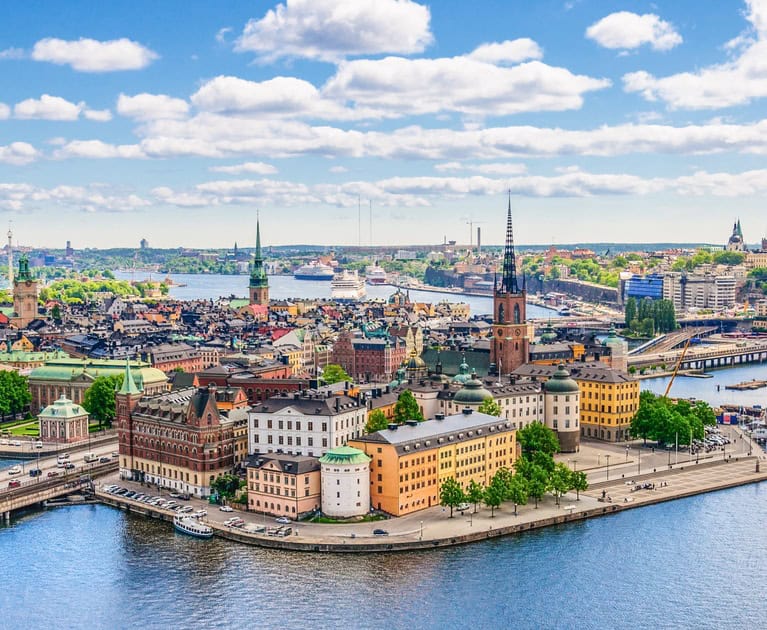
Elegant Stockholm is nestled where Lake Mälaren’s cobalt waters meet the Baltic. This stunning cultural capital extends over 14 islands linked by 57 graceful bridges. Hailed as one of the world’s cleanest cities, it boasts numerous green parks. The well-preserved 13th-century Gamla Stan, or old town, boasts gabled merchant houses and an array of architectural styles, from the enormous baroque Stockholm Palace to the art nouveau Royal Dramatic Theater. Strandvägen is one of Europe’s loveliest waterfront esplanades and the ideal place to sample some traditional smoked salmon.
Stockholm is an open book for those interested in Swedish culture and history; the city has one of the highest concentrations of museums in the world. The most prominent is the maritime Vasa Museum, which houses the restored 17th-century ship Vasa. Other homestead reconstructions are spread across the Skansen open air museum on the isle of Djurgården, providing a glimpse of life before the Industrial Age. Art lovers may also linger among the thousands of paintings and handicraft pieces at the National Museum or admire works by Picasso and Dalí at the Moderna Museet.
The capital of Estonia, Tallinn is located along the coast of the Baltic Sea. Its well-preserved old town, a UNESCO World Heritage Site, is surrounded by a ring of 17th-century historic fortifications that were built to protect the city from invaders. Inside its walls are the upper town, where the regal castle and the cathedral are located, and the lower town, a maze of merchants’ houses, guilds, churches and public buildings. Some of the most notable landmarks include the Town Hall Square, Alexander Nevsky Cathedral, St. Olaf’s Church and the Kumu Art Museum.
Riga is the largest and most cosmopolitan of the Baltic capitals. Here, medieval meets contemporary in a history and architecture lover’s dream. Vaulting gothic spires and domes of ancient churches dot the narrow cobblestone streets of the UNESCO-listed Old Town, while wide boulevards host striking and ornate examples of stunning Jugendstil Art Nouveau buildings in the new town. Upscale shops mingle with modern art galleries and hip bars, amid innovative, candlelit restaurants, creating a vibrant atmosphere, day or night.
A member of the Hanseatic League, Riga has a fascinating history. The heart of its UNESCO-listed Old Town acts as a living museum with its labyrinth of narrow streets and historic squares. The city is home to a diverse population, including sizeable Russian- and Ukrainian-speaking communities, bringing a peaceful blend of customs and languages. Europe’s largest collection of Art Nouveau architecture is found in Riga. The expansion of the city and explosion of the movement during the late 19th century has left a tapestry of magnificent buildings featuring elaborate facades.
Lithuania’s third-largest city is a historic port on the Curonian coast. Part of the Prussian Kingdom until 1923, when it won its autonomy, Klaipėda is divided by the Danė River, which flows through the city into the Baltic Sea. Along its left bank, the historic old town features cobblestone streets with historic German-style half-timbered houses, street art and a tree-lined promenade filled with cafés. The new town stretches along the Danė’s right bank, past industrial sites and shipyards, amid venues that showcase the city’s art and cultural heritage.
Gdańsk is widely known as the city of glowing amber and Gothic cathedrals. Its luster harkens back to medieval times when it was one of the most prosperous cities in the Hanseatic League, the mercantile powerhouse of the Baltic. The city’s rich history is on display in the remarkably restored old town, a splendid mix of Gothic, Renaissance and Baroque styles—from the royal residence of Green Gate to the 15th-century Artus Court, a merchant’s palace. Traditional Polish pierogies or a glass of Goldwasser, a liqueur created here during the 16th century, round out any visit.
Copenhagen’s skyline lies distinctly low to the ground, but some architectural elements soar above all else: the city’s church spires and palace towers. For this reason, the Danish capital is often called the “City of Spires.” Perhaps the most unique, the baroque Church of Our Savior features a spiral stairway that hugs the outside of the steeple. Christian IV’s former stock exchange building boasts a “dragon spire” resembling the entwined tails of four beasts, and the City Hall and Christiansborg Palace strike their own dramatic pose.
Bid farewell to your fellow guests and journey home.
Find a personal travel manager to make an enquiry
Advertised prices are per person twin share, correct at time of publication and are subject to availability and change and can be withdrawn or amended at any time without notification due to fluctuations in charges, taxes and currency. Offer is not combinable with any other offer. Prices are per person, in Australian Dollars, based on double occupancy, subject to availability, includes all advertised discounts, correct at time of printing, and cannot be used in conjunction with any other offer. ^Companion Fly Free is a return economy flight for one passenger up to the value of AU$2,500 per booking. It applies to selected 2026, 2027 and 2028 Ocean voyages and is to be used towards flights booked by Viking on Viking’s choice of airline from major gateway cities in Australia and New Zealand. Should the applicable airfare be higher than the value of the Companion Fly Free offer, guests are required to pay the difference. Any unused portion of the included Companion Fly Free value is forfeited and cannot be transferred towards any other portion of the booking or any other person. Companion Fly Free flight offer only valid if booked in conjunction with selected Viking Ocean cruises. Both guests must be on the same flight booking and fly together in both directions. Flight offers and the deposit amount varies for World Cruises, Longitudinal World Cruises, and Grand Journeys. Companion Fly Free offer excludes the Grand Australian Circumnavigation itinerary. All offers only valid on new bookings made between 03 October 2025 and 03 November 2025 at 7pm AEST and is a strictly limited offer; conditions apply and may be withdrawn at any time unless sold out prior. For full terms and conditions visit viking.com. Itineraries subject to change. Change and cancellation fees may apply. Your personal travel manager may charge additional service fees. Other conditions apply. Please view the TravelManagers general terms and conditions here and contact your personal travel manager for more details.
TravelManagers respects and honours the Traditional Custodians of the land and pay our respects to their Elders past, present and future. We acknowledge the stories, traditions and culture of Aboriginal and Torres Strait Islander peoples on the lands where we work and gather, and those we visit.