
Fly for free^
Cruise down the historic Danube, with stops at these destinations:
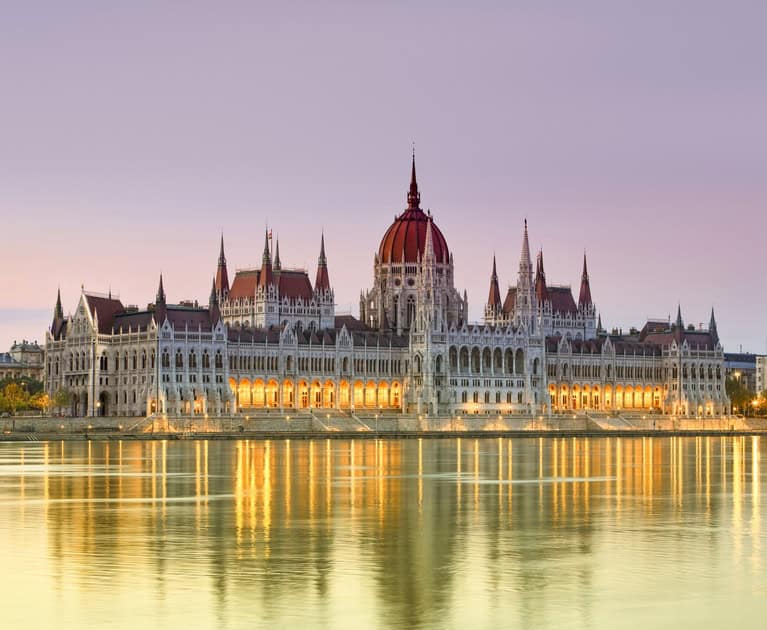
Embark your ship and settle into your stateroom. Riverside beauty and a vibrant cultural scene blend together in Budapest to form one of Europe’s most rewarding cities. Hungary’s enchanting capital straddles the banks of the Danube, with traditional hillside Buda on one side and modern Pest on the other. By day, stunning art nouveau buildings, stalwart castles and grand palaces set the stage for inspiring strolls and long soaks in thermal spas. By night, the shimmering lights of the Parliament building dance across the waters of the Danube, the Chain Bridge uniting it all as a dramatic centrepiece.
Budapest’s old town is a fascinating medieval patchwork of narrow streets and colourful houses. In the Castle District, the Matthias Church soars in Gothic glory. Adjacent, the expansive wall and seven turrets of Fisherman’s Bastion overlook the Danube, the graceful Chain Bridge and the Pest side of the river. The centrepiece of the district is the sprawling Buda Castle. Constructed in the 13th century and expanded to its current baroque splendour during the 18th century, this edifice was home to Hungary’s kings for almost 700 years.
Renowned as the “City of Waltzes,” Austria’s capital city of Vienna is Europe’s centre of classical music. Strauss and Mozart composed many of their finest pieces here. Vienna’s musical history is matched by the elegant, graceful architecture that lines the Ringstrasse, the wide boulevard encircling the Inner City. Baroque, neo-Renaissance, Gothic-Romanesque and other splendidly styled structures, from the Hofburg Palace to the Vienna State Opera, take the breath away with their grand facades. Vienna has a more intimate side too: inviting footpaths lead through green parks and its famed Viennese cafés sweeten any stay with coffee and the city’s delectable Sachertorte.
Vienna is considered one of Europe’s greatest cultural hubs. Its art scene has long been established with the Hapsburg’s collection of fine art, now housed at the Kunsthistorisches Museum. Today, Vienna’s modern side showcases street art murals that don the side of buildings along the banks of the Danube. Ingrained in local life is the long-embraced tradition of coffeehouses; UNESCO includes Viennese coffeehouse culture on its list of Intangible Cultural Heritages. It is considered one of life’s pleasures to while away an afternoon over an Einspänner coffee and a pastry.
A small university town at the eastern end of the Danube’s Wachau Valley, Krems is surrounded by terraced vineyards. In its heyday, during the 12th century, Krems held even more importance than Vienna for its iron, grain, salt and wine trade. As to the latter, the city has played a long and celebrated part in the popularity of the Wachau’s wine culture; the valley’s south slopes in Krems are bathed in sunlight all day and create some of the best Riesling and Veltliner wines in the world. The city’s cobblestone streets, taverns, wine bars and coffeehouses have a timeless appeal.
Founded by the Celts over 2,000 years ago, Passau is one of Bavaria’s oldest cities. Known as the “City of Three Rivers,” it rests at the confluence of the Inn, Ilz and Danube rivers. The city has long enjoyed its strategic position and grew to great economic and political power because of it. The legacy of its past prosperity lives on in graceful arcades, colourful houses with rococo facades and the glorious baroque St. Stephen’s Cathedral, home to one of Europe’s largest pipe organs. Passau is also where two nations meet; it is here that the German-Austrian border begins.
Having escaped major damage during World War II, the picturesque town of Regensburg is one of Europe’s best-preserved medieval cities, the oldest city along the Danube and a UNESCO World Heritage Site. The Old Stone Bridge, constructed in the 12th century, is a masterpiece of medieval engineering with its 16 arches. St. Peter’s Cathedral is widely considered Bavaria’s best Gothic architectural work. The old town’s Neupfarrplatz square is a cross section of history—it was once a thriving Jewish quarter, a bustling marketplace and the site of Nazi book burnings.
Bid farewell to your fellow guests and journey home.
Find a personal travel manager to make an enquiry
Advertised prices are per person twin share, correct at time of publication and are subject to availability and change and can be withdrawn or amended at any time without notification due to fluctuations in charges, taxes and currency. Offer is not combinable with any other offer. Prices are per person, in Australian Dollars, based on double occupancy, subject to availability, includes all advertised discounts, correct at time of printing, and cannot be used in conjunction with any other offer. ^Fly Free is for economy class and up to the value of AU$2,500pp. It applies to selected 2026, 2027 and 2028 river voyages and are to be used towards flights booked by Viking on Viking’s choice of airline from major gateway cities in Australia and New Zealand. Should the applicable airfare be higher than the value of the Fly Free offer, guests are required to pay the difference. Any unused portion of the included Fly Free value is forfeited and cannot be transferred towards any other portion of the booking or any other person. Flight offers only valid if booked in conjunction with selected Viking River cruises. All offers only valid on new bookings made between 03 October 2025 and 03 November 2025 at 7pm AEST and is a strictly limited offer; conditions apply and may be withdrawn at any time unless sold out prior. For full terms and conditions visit viking.com. Itineraries subject to change. Change and cancellation fees may apply. Your personal travel manager may charge additional service fees. Other conditions apply. Please view the TravelManagers general terms and conditions here and contact your personal travel manager for more details.
TravelManagers respects and honours the Traditional Custodians of the land and pay our respects to their Elders past, present and future. We acknowledge the stories, traditions and culture of Aboriginal and Torres Strait Islander peoples on the lands where we work and gather, and those we visit.