


If you’ve always dreamed of seeing the world’s greatest natural light show, 2026 could be the perfect year to make it happen. Scientists expect the current solar cycle to reach one of its most active phases around this time, creating ideal conditions for spectacular displays of the Northern Lights.
That means travellers heading to aurora hotspots such as Norway, Finland, Iceland and Canada may have a better chance of seeing brighter and more frequent aurora displays than usual.
You don’t need to be an astrophysicist to make the most of this once-in-a-decade opportunity. Our handy guide explains what causes the Northern Lights, why 2026 is expected to be such a strong year for aurora viewing, and where and when to travel for the best chance of witnessing the Aurora Borealis.
This breathtaking natural phenomenon has been captivating humankind for thousands of years – there are cave paintings in northern Spain, created by Cro-Magnon humans in around 30,000 BCE, which are thought to be the earliest known depictions of the Northern Lights. They are also described in ancient Japanese folklore, Chinese legends, Norwegian chronicles, and even in the writings of the Greek explorer Pytheas, who witnessed the sight during his journey to northern Europe in around 325 BCE.
These earliest observers described the spectacle as “falling red flames”, “red pheasant tails” and “daylight in the night”. In reality, it occurs as the result of disturbances to the Earth’s magnetosphere (the teardrop-shaped region of space that surrounds our planet) which are caused by enhanced speed of solar winds.
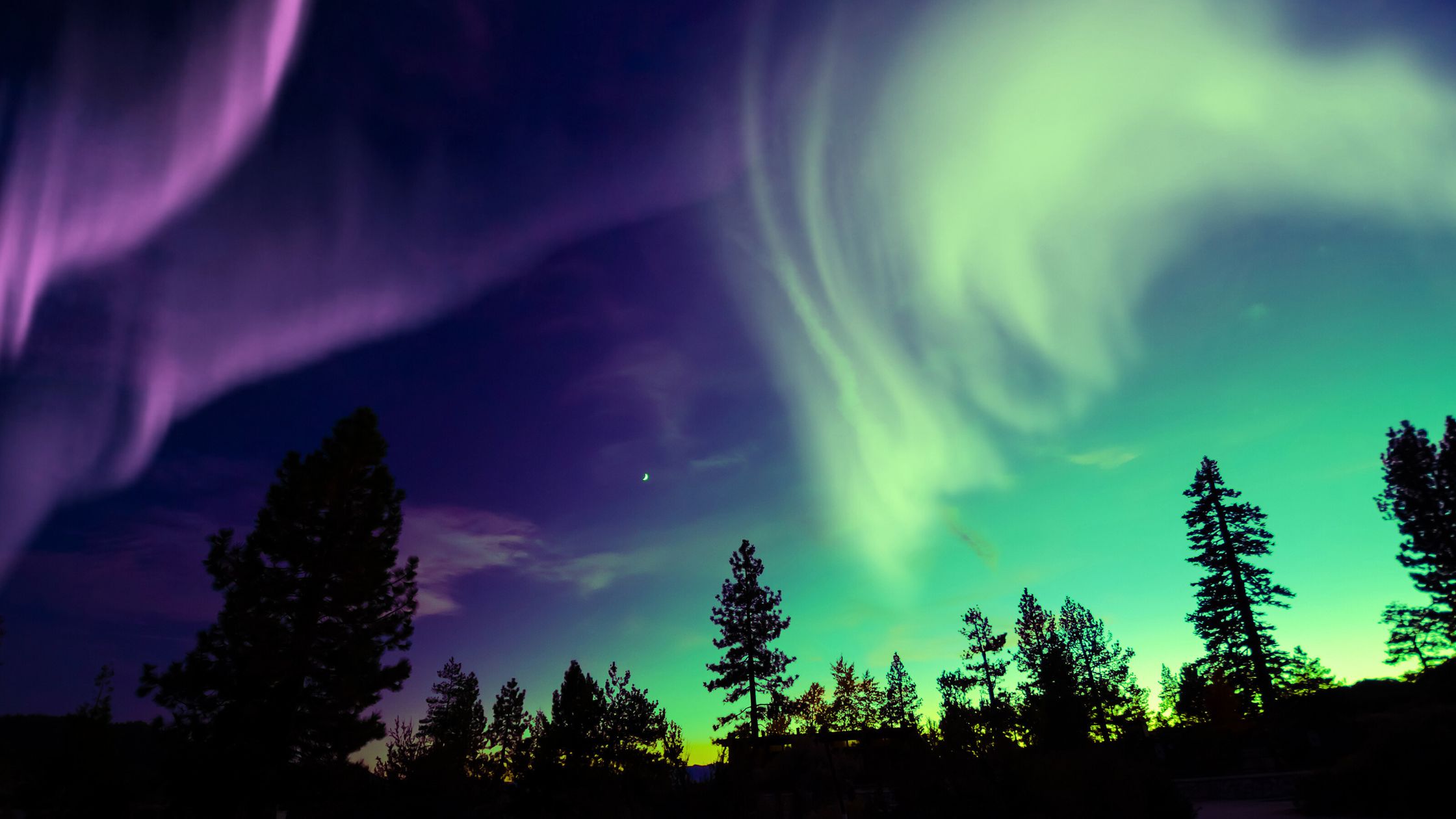
The most common cause is known as a coronal mass ejection (CME), which is an ejection of plasma from the sun’s corona. As a result, charged particles from the magnetosphere are pushed into Earth’s upper atmosphere where they are ionised, creating the vibrant display of red, green and purple light that we see as the Aurora.
Our sun is a huge ball of hot, electrically charged gas that generates a powerful magnetic field. Roughly every 11 years, the Sun’s magnetic poles flip, marking the start of a new solar cycle.
During each cycle, solar activity gradually builds before reaching its most intense phase, known as the solar maximum. At this point the Sun produces more sunspots, solar flares and coronal mass ejections (CMEs) – powerful bursts of charged particles that travel through space.
When these particles interact with Earth’s magnetic field, they energise gases in our upper atmosphere and create the glowing ribbons of colour we know as the aurora.
Scientists expect Solar Cycle 25 to reach its most active phase around 2025–2026, which means aurora displays are likely to be stronger, more frequent and sometimes visible further south than usual. Because of this increased solar activity, the 2026 aurora season is widely expected to be one of the best opportunities in more than a decade to see the Northern Lights.
All this activity takes place within the Auroral Ovals, which are doughnut-shaped areas of activity that surround our planet’s magnetic north and south poles. The exact size, shape and location of the ovals is prone to change, according to the ever-shifting levels of solar activity.
During periods of intense solar activity, we can sometimes view the aurora at locations closer to the equator. However, the best and most consistent destinations for viewing the Aurora Borealis (and its Southern Hemisphere counterpart, the Aurora Australis) lie within the Aurora Zones of 60 to 75 degrees of latitude.
The Northern Hemisphere’s Aurora Zone encompasses Scandinavia, Greenland, Canada, Alaska and Russia. In the Southern Hemisphere, it covers the southernmost parts of New Zealand, Australia, Chile, Argentina, the Falkland and South Georgia Islands, and Antarctica.
To find out more about our six favourite places to see the Northern Lights, check out our blog.
Although aurora activity happens year-round, viewing conditions for the Aurora Borealis are optimal during the longer nights between September and March. The peak aurora viewing season is from December to February, in the heart of the northern winter.
As with any light show, you need clear, dark skies far from any source of light pollution, which is why winter nights in more remote areas make for the best Aurora-watching conditions.
The most common time for the Aurora to make an appearance is between 6pm and 2am, when the skies are darkest. Even in optimal viewing conditions, the aurora can be an elusive creature, so be sure to wrap up extra warm and be prepared to settle in for a long and sometimes futile wait.
The appearance of the Northern Lights is dependent on a variety of factors, including solar activity, weather conditions and darkness levels. Some nights they won’t appear at all, while other nights you can watch them dancing across the sky for hours.
There are plenty of scientists and aurora enthusiasts who pour a huge amount of time and effort into tracking and predicting aurora activity at a local, regional and global level. You’ll find regular updates and forecasts published on various aurora websites, as well as on aurora-watching groups on social media.
Not necessarily, although you will have better viewing conditions as you move further from urban areas where light pollution reduces visibility. If you don’t fancy bundling up against the cold, you could opt for an overnight stay in a glass igloo so you can watch the show from the comfort of your own bed.
If you’re booked on a night flight within the Aurora Zone, you can request a window seat and watch out for the light show during your journey.
Displays can last from a few brief minutes to several hours, depending on viewing conditions.
Again, it depends on the viewing conditions, but yes, the Northern Lights are often visible to the naked eye. However, most modern smartphones are equipped with cameras that operate in night mode. Their sensors are more sensitive to colours in the dark and able to accumulate more light over a longer period of exposure.
As a result, on nights when the Aurora is barely visible to the naked eye, you may find that your camera delivers a much more vibrant view.
Not necessarily, although the Aurora is certainly a photographer’s dream. A smartphone is very capable of capturing spectacular images, especially if you are skilled at adjusting exposure time and light sensitivity settings.
The best cameras for Aurora photography are DSLR or mirrorless, ideally used with a wide-angle lens and fast aperture setting. Using a tripod will ensure maximum stability for those long exposures. The near-freezing conditions will drain your batteries more quickly, so be sure to pack plenty of spares and keep them in an insulated bag.
Guided tours can enhance your chances of seeing the Northern Lights because they will keep an eye on the conditions and use their expert local knowledge to choose the best viewing sites. You can also opt for a specialised tour that will teach you everything you need to know about aurora photography, or one that delves a little deeper into the science behind the spectacle.
Aurora watching requires plenty of patience, and often requires you to spend long periods outdoors in freezing conditions, so you’ll need to be well prepared to make your viewing experience as enjoyable as possible. Dress in layers of thermal or wool clothing, with a waterproof outer layer and insulated hat, boots and gloves. In popular Aurora watching destinations such as Tromsø (Norway), Rovaniemi (Finland), and Yellowknife (Canada), you can hire suitable outer layers and boots.
The opportunity to see the Northern Lights during the solar maximum occurs every eleven years. If you’re excited to tick off this bucket-list experience, get in touch with your Personal Travel Manager today.
TravelManagers respects and honours the Traditional Custodians of the land and pay our respects to their Elders past, present and future. We acknowledge the stories, traditions and culture of Aboriginal and Torres Strait Islander peoples on the lands where we work and gather, and those we visit.